Showing posts with label Turner. Show all posts

Sunday, March 31, 2019

Isaiah 43.16-21: Imperceivable

I am about to do a new thing; now it springs forth, do you not perceive it? So God asks through the prophet Isaiah (Isaiah 43:16-21). And the answer is, "Sometimes."

Sometimes God's "new thing" is as obvious as the Armory Show of 1913. The Armory Show, officially the International Exhibition of Modern Art, shocked the country when it opened in New York at the 69th Regiment Armory. Designed to introduce American audiences - who were used to Rembrandts and Raphaels - to the most contemporary art, the Armory show indeed attracted many visitors. More than 200,000 ticket-holders were willing to stand in long lines to see the work. 

What those exhibition-goers saw was so unlike what had come before that everyone had an opinion. Harriet Monroe defended the show and the artists, writing, "In a profound sense these radical artists are right. They represent a search for new beauty, impatience with formulae, a reaching out toward the inexpressible, a longing for new versions of truth observed." By contrast, a critic for the New York Times described the Marcel Duchamp painting below as looking like "an explosion in a shingle factory." That this was a new thing was perceived, to be sure. 
Marcel Duchamp. Nude Descending a Staircase No. 2. 1912. Philadelphia Museum of Art.
Impressionism seems to have been a "thing" as new as the Armory Show was. Monet's painting below, Impression: Sunrise, was the work that gave the movement its name. And the name wasn't particularly flattering. A critic, upon seeing both Monet's painting and the show in which it was first exhibited, wrote that all the paintings were "just impressions." This oh-so-new thing was not well-received by the wider public.
Claude Monet. Impression: Sunrise. 1872. Paris: Musee Marmottan.
But what if this oh-so-new thing really wasn't as new as we think. The Impressionists were influenced by the work of English artist J.M.W. Turner. Turner's work uses the brightened palette and broken brushstrokes for which the Impressionists are known. The painting detail below is every bit as impressionistic as the French painters' work was, but Turner was painting decades before the Impressionists. Or what about the Spanish artist Goya? In his Milkmaid of Bordeaux, his technique is easily characterized as "Impressionistic." And look at when that painting was done.
J.M.W. Turner. Rain, Steam, and Speed (detail). 1844. London: National Gallery. 

Goya. The Milkmaid of Bordeaux (La Lechera de Burdeos). 1827. Madrid: Museo del Prado.
A new thing that springs forth...do you perceive it? Sometimes yes. Sometimes that new art thing is as big and bold as you please and you really couldn't miss it if you tried. But sometimes the changes can only be seen in retrospect. You think nothing is changing, but all of a sudden you look back and understand the change was coming all along.

It's true in art. And it's true with God. 

Paths...new ones, old ones, God ones...take a look at Art&Faith Matters' Facebook page here.
For thoughts on John 12.1-9, click here.

Sunday, November 26, 2017

Isaiah 64.1-9: Rain, Steam, Speed

The words of the prophet Isaiah are featured the first three weeks of Advent in year B of the Revised Common Lectionary. For Advent 1B, the specific text is Isaiah 64:1-9. In this passage Isaiah prays that God will tear open the heavens, come down, and perform the awesome deeds for which God is known. Those awesome deeds seems more frightening than comforting: the ground shakes, nations tremble. The prophet offers the descriptive parallel of water made hot enough to boil. The combination might truly be terrifying.

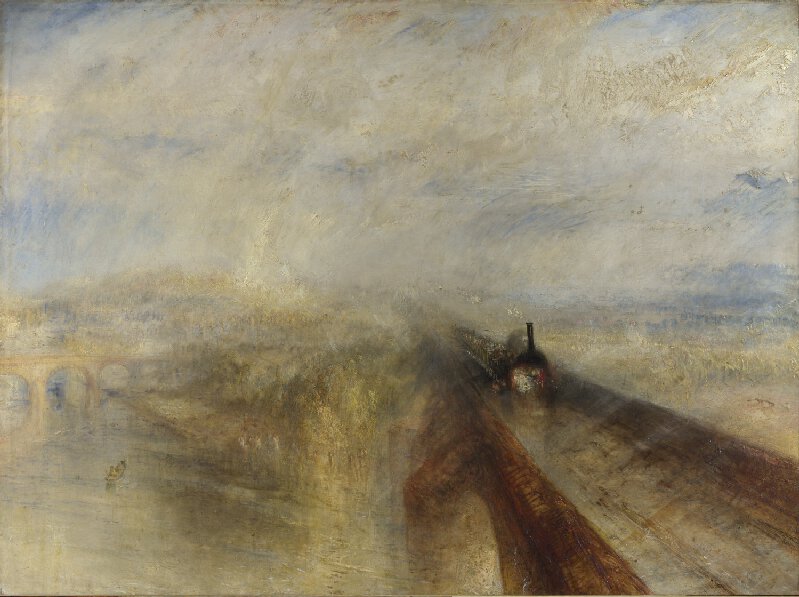
Though it does not especially look like it, English painter J.M.W. Turner captured an experience that was literally as ground-shaking as the prophet calls for. The painting Rain, Steam, Speed captures a time when the railroad was changing England. Where development of cities and civilization had previously required access by navigable waters, the railroad made it possible for industry to develop in non-waterside locations. Goods and people could be transported by the railroad. But Turner gives the train more symbolism than that.
J.M.W. Turner. Rain, Steam, Speed. c. 1844. London: National Gallery. 
For Turner, the train tears through the landscape, a dark gash against blue and gold. The bridge and train separate a man in a boat on the river (to the left of the bridge) from a farmer plowing his field (to the right of the bridge). At the left is the increasingly irrelevant road bridge that crosses the river. The boat is powered by the man; the plowing is powered by the animals. The train, of course, is powered by steam. Small bits of red and white paint on the engine are not realistic - there was no way to see through to the engine's firebox. But those paint smudges symbolize the fire that burns, causing water to boil and turn to steam which is harnessed, powering the locomotive.

The train thunders across a bridge (traditionally identified as the Maidenhead railway bridge, across the Thames between Taplow and Maidenhead). Passengers sit in open-air cars behind the engine. They can feel the mist of the steam and the rain as they travel at 50 heart-stopping, breathtaking miles an hour.

O that you would tear open the heavens and come down. Mountains quaking, fire kindling, water boiling. And God's presence is known. Heart-stopping. Breathtaking.

You have hidden your face from us, and have delivered us into the hand of our iniquity.

One of the details that easily escapes notice in the painting is the rabbit. Yes, there is a rabbit. It is running directly in front of the train. What exactly does the hare mean? Is nature going to be vanquished - or at least forced to succumb to "progress"? Is technology about to run over the rabbit? Have we been delivered into the hand of our iniquity? Or is the rabbit still faster than the train? Can we see it as God working for those who wait for God?
Rain. Steam. Speed. Torn heavens and quaking earth. Kindled fire and boiling water. And the first Sunday as we wait for the God who is to come. Do not be exceedingly angry, O LORD, and do not remember iniquity forever. Now consider, we are all your people.


For thoughts on the gospel lesson for Advent 1B, click here.
For additional thoughts on the impact of steam and the earth, click here or on the Facebook link below.