Showing posts with label Isaiah. Show all posts

Sunday, January 19, 2020

Isaiah and Matthew: Zebulun and Naphtali

Zebulun was the sixth and final son of Jacob and Leah. Naphtali was Jacob's sixth son, the second with Bilhah. The tribes of Zebulun and Naphtali had received land that made them a target for invading enemies. Those lands had been annexed by various Assyrian kings. Living as a possession of the Assyrians had brought times of despair and anguish. Isaiah 9:1 promises that the time of gloom will one day end for the lands of Zebulun and Naphtali. God will break into their lives, bringing light and life.

Matthew 4:15 has Jesus moving to Capernaum, a fishing village on the northern shore of the Sea of Galilee in order to fulfill Isaiah's prophecy. For the gospel's audience, "Assyria" would be heard as "Rome," another empire that had taken control of Zebulun and Naphtali (and all the other tribes' lands, too).

Marc Chagall created a series of twelve stained glass windows for the Hadassah Medical Center in Jerusalem. Each window represents one of the twelve tribes. The windows are arranged in groups of three on four walls that create a square. Zebulun and Naphtali are pictured here, both the stained glass windows themselves and lithographs that Chagall created with the same designs.
Marc Chagall. Zebulun. (left, stained glass) Hadassah Medical Center. Jerusalem. (right, lithograph) from The Twelve Maquettes of Stained Glass Windows for Jerusalem
The Zebulun window is dominated by the color red and elements of life in, on, and around the sea. In the bottom left is a boat, symbol of a tribe who became noted for navigation, as the tribe's blessing from Jacob indicated:
13 ‘Zebulun shall settle at the shore of the sea; he shall be a haven for ships,
and his border shall be at Sidon. Genesis 49:13.
Fish jump toward one another above a horizon line that (in the lithograph anyway) features a lavender sun. The letters spelling out Naphtali's name arc across the top of the design.
Marc Chagall. Naphtali. (left, stained glass) Hadassah Medical Center. Jerusalem. (right, lithograph) from The Twelve Maquettes of Stained Glass Windows for Jerusalem
The Naphtali window, with a yellow background, also features elements of Jacob's blessing:
‘Naphtali is a doe let loose that bears lovely fawns. (Genesis 49:21)
The doe lies on the ground somewhat under a treeflies an eagle, symbol of freedom. At the right of the composition is a tree, while a bird of some kind (variously identified as an eagle or a rooster or the generic "bird"), which are often symbols of freedom. The small(er) letters spelling Zebulun are right against the top of the arch.

Land of Zebulun, land of Naphtali, on the road by the sea, across the Jordan, Galilee of the Gentiles
the people who sat in darkness have seen a great light, and for those who sat in the region and shadow of death light has dawned. It's good news whether it's in Isaiah or Matthew.

See very different versions of Zebulun and Naphtali on Art&Faith Matters on Facebook.

For additional thoughts on Isaiah and Matthew, click here.

Sunday, December 8, 2019

Isaiah 7.10-16: Ask for a Sign

"Ask for a sign," Isaiah invites Ahaz. But Ahaz won't ask. (Isaiah 7:10-16) Maybe he didn't ask because he was afraid of what the sign would be. The sign-giver in the text is God, speaking through the prophet. The sign is meant to communicate the future of Ahaz' rule.

Sign painters in decades and centuries past didn't necessarily consider themselves artists, but they were definitely communicators on a giant scale. There work was as small as a card in a window and as large as the side of a building or the roof of a barn. The job was to make information as understandable as possible through size of letters, placements of words, and use of color. The information had to be comprehensible even from a moving car and persuasive. The point of the sign was to influence the viewer: to draw them into a shop or bring them to a tourist attraction or to sway them to try a product. The message had to be unmistakable.
 (Left) Uneeda Biscuit advertising mural on the side of the Union Hotel in Meridian, MS. 
(Right) "See Rock City" barn roof gets a new coat of paint. 
God gave the same kind of sign to Ahaz, even when Ahaz didn't want one. God's sign was a young woman who would have a child. The child would eventually replace Ahaz on the throne. God wrote it big. So big that we don't hear from Ahaz again in scripture until Isaiah 14:28 in an oracle dated the same year as Ahaz' death.

For additional information on the (almost) lost art of hand-painting signs, see The Pre-Vinylite Society, Brain Pickings, Craftsmanship Magazine, or the film.

For thoughts on Matthew 1:18-25, click here.

Sunday, March 31, 2019

Isaiah 43.16-21: Imperceivable

I am about to do a new thing; now it springs forth, do you not perceive it? So God asks through the prophet Isaiah (Isaiah 43:16-21). And the answer is, "Sometimes."

Sometimes God's "new thing" is as obvious as the Armory Show of 1913. The Armory Show, officially the International Exhibition of Modern Art, shocked the country when it opened in New York at the 69th Regiment Armory. Designed to introduce American audiences - who were used to Rembrandts and Raphaels - to the most contemporary art, the Armory show indeed attracted many visitors. More than 200,000 ticket-holders were willing to stand in long lines to see the work. 

What those exhibition-goers saw was so unlike what had come before that everyone had an opinion. Harriet Monroe defended the show and the artists, writing, "In a profound sense these radical artists are right. They represent a search for new beauty, impatience with formulae, a reaching out toward the inexpressible, a longing for new versions of truth observed." By contrast, a critic for the New York Times described the Marcel Duchamp painting below as looking like "an explosion in a shingle factory." That this was a new thing was perceived, to be sure. 
Marcel Duchamp. Nude Descending a Staircase No. 2. 1912. Philadelphia Museum of Art.
Impressionism seems to have been a "thing" as new as the Armory Show was. Monet's painting below, Impression: Sunrise, was the work that gave the movement its name. And the name wasn't particularly flattering. A critic, upon seeing both Monet's painting and the show in which it was first exhibited, wrote that all the paintings were "just impressions." This oh-so-new thing was not well-received by the wider public.
Claude Monet. Impression: Sunrise. 1872. Paris: Musee Marmottan.
But what if this oh-so-new thing really wasn't as new as we think. The Impressionists were influenced by the work of English artist J.M.W. Turner. Turner's work uses the brightened palette and broken brushstrokes for which the Impressionists are known. The painting detail below is every bit as impressionistic as the French painters' work was, but Turner was painting decades before the Impressionists. Or what about the Spanish artist Goya? In his Milkmaid of Bordeaux, his technique is easily characterized as "Impressionistic." And look at when that painting was done.
J.M.W. Turner. Rain, Steam, and Speed (detail). 1844. London: National Gallery. 

Goya. The Milkmaid of Bordeaux (La Lechera de Burdeos). 1827. Madrid: Museo del Prado.
A new thing that springs forth...do you perceive it? Sometimes yes. Sometimes that new art thing is as big and bold as you please and you really couldn't miss it if you tried. But sometimes the changes can only be seen in retrospect. You think nothing is changing, but all of a sudden you look back and understand the change was coming all along.

It's true in art. And it's true with God. 

Paths...new ones, old ones, God ones...take a look at Art&Faith Matters' Facebook page here.
For thoughts on John 12.1-9, click here.

Sunday, March 17, 2019

Isaiah 55.1-9: This is Not Bread

The prophet asks, "Why spend your money on things that aren't bread?" (Isaiah 55:1-9) Why spend your money on things that don't sustain life? Why exchange your work for things that don't satisfy? The world is full of things that look like they sustain life. There are many things for which we work that ultimately do not satisfy. But those things can be so attractive that we forget they aren't life-sustaining or ultimately satisfying. Dutch still life painters created an entire genre of paintings that model the prophet's question.

Seventeenth-century still life paintings show us beautiful arrangements of flowers, photorealistic depictions of silver goblets, blue and white Delftware and tablecloths that make us want to get out an iron and ironing board. There is lobster and bread, lemons and oysters, peaches and pastries. There are cherries, strawberries, bunches of grapes, and wheels of cheese. The food looks delectable. Good enough to eat, even 400 years later.
Clara Peeters. Still Life with Cheeses, Artichokes and Cherries. c. 1625. Los Angeles County Museum of Art.
Clara Peeters, the only Flemish woman artist known to have specialized in still life paintings, used mostly local foods - cheeses, artichokes, cherries, bread - in the work shown here. It might be an illustration for a local farmer's market or restaurant. It might be. But it isn't.

As are many still life paintings of this period, Peeter's painting is a reminder of the transience of the things of this world. The artichoke, sliced in half, is already starting to brown. The bread and cheese are sitting out getting hard and stale. One of the cherries has been eaten, the pit and stem lying on the table by the sliver of artichoke.

The food won't last. It will not ultimately satisfy. Eat this food, and you'll be hungry again. Why spend your money on things that aren't bread? Why exchange your labor for things that won't ultimately satisfy you? The prophet offers an alternative. Keep reading Isaiah and find out what it is.

This week on Art&Faith Matters on Facebook...the generation of women artists who came after Clara Peeters.

For thoughts on Luke 13:1-9, click here.

Sunday, May 20, 2018

Isaiah 6.1-8: Scale

Isaiah's call story (Isaiah 6:1-8, Trinity B) is full of imagery: seraphim, thrones, burning coals. Artists like Mark Chagall have depicted the call in many ways. The call forms the center portion of Chagall's portrait of the prophet. The seraphim touches the burning coal to Isaiah's lips.
Marc Chagall. The Prophet Isaiah. 1968. Musee Marc Chagall, Nice, France.
Surely that is a dramatic moment, but the artist has put us in a position outside the action. We are spectators watching what happens at a distance. The seraphim is roughly human sized, and the collection of background figures remove the sense of reality. The text, however, gives us a very definite scale of the action. And it isn't this.

The text tells us that the Lord is sitting on a throne and the royal robe is so immense that the hem...just the hem...fills the Temple. The Temple is filled by the hem of the robe. There is no sense of that scale in Chagall's work. which has Isaiah as the largest figure in the composition. Everything is scaled to human proportions.

The difference is important because the scale indicated by the text puts human beings directly in front of the vastness and power of God. And in the face of the hugeness of God, humans understand that they are small. Consider the difference between watching a movie at a movie theater and watching it on a computer. The shipwreck, the space travel, the desert...all of them are more impressive, more immersive, on a theater screen than on a laptop. The difference is the scale of the scene in relation to human beings.

To give you a sense of what a difference scale makes, compare the viewpoint of Chagall's Isaiah with the painting below. The story it illustrates also involves the hem of a garment hem and a touch. It is the artist's point of view and the scale of the painting compared to the viewer that makes us feel small, low, and vulnerable. That helps us understand just how low and vulnerable the woman who sought healing was willing to make herself.
Daniel Cariola. Encounter. 2016. Encounter Chapel, Magdala (Migdal), Israel.
The photo below offers a glimpse of scale from the natural world. Here the Aurora Borealis (Nothern Lights) dance above the Lofoten Islands in Norway. The lights of the town are bright (and probably a little brighter here than they would normally be in order to have a long exposure for the sky), but next to the vastness of the aurora...
Alex Conu. Northern Lights Above Lofoten. 2015. Astronomy Picture of the Day, June 26, 2016.

For additional thoughts on scale, see this week's Facebook post. 
For thoughts on Nicodemus (John 3:1-17), click here.
For Facebook thoughts on the call of Isaiah, click here.

Sunday, January 28, 2018

Isaiah 40.21-31: God's View

How we human beings strive to be seen as important in our world. Some people will trade everything that should matter to them in order to be powerful and important according to the world's assessment. But perhaps we should remember how we look when seen from a different point of view. Isaiah tells us that we look like insects from where God is sitting (Isaiah 40:21-31, Epiphany 5B). God sits above the circle of the earth, and the earth's inhabitants look like grasshoppers. 

With that in mind, you can probably work out the subject matter of the contemporary painting below. 
Nina Brooke. Shoreline. Available as a giclee print. https://www.ninabrooke.co.uk
Painter (and surfer) Nina Brooke has painted the beach from above. This view is closer to what the prophet describes in the lectionary text. The individual people look like small dark smudges against the tan of sand, the white of waves and the blue-green of the water. No individual features are recognizable. No distinctions of class or race are easily evident. The people move as groups and individuals, they move closer together and father apart, echoing the ebb and flow of waves and tides. The view from above can be no more detailed than that.

And yet, God's care is for each of those moving specks. God has promised that each of those little faceless specks can, if they wait on God, renew their strength. Each of those featureless dots can, if they wait on God, mount up with wings like eagles. Each of those indistinguishable blobs can, if they wait on God, run and not be weary. Each of those ant-sized beings can, if they wait on God, walk but not faint. They just have to wait on God. In other words...Patience (but wait eagerly), young grasshopper.

This week on Art&Faith Matters' Facebook page, how we, in 1936, got a little closer to God's view.

For thoughts on Jesus' search for a deserted place in this week's gospel reading (Mark 1:29-39), click here.

Monday, January 1, 2018

Isaiah 60:1-6: Epiphany and Baptism: A Story of Getting Up

Arise, shine! directs the prophet. For your light has come, and the glory of the Lord has risen upon you.. The text is the reading from Hebrew scripture for Epiphany B (Isaiah 60:1-6), but the verbs also work well with the neighboring liturgical day, the Baptism of the Lord. One of the things they all have in common is movement.

The magi must actually prepare for and then set out on the journey. If they want to see for themselves, no amount of talking about astronomy or geography or history is going to get the answers they want. They have to get up and go. 

At his baptism, Jesus doesn't stay in/under the water. He must move up from or out of the water. It is as Jesus comes up out of the water that the dove descends and the voice is heard (who hears the heavenly voice depends on which gospel you are reading). 

When people are healed by Jesus, they get up and go back to the work they were doing or they join Jesus on the way. Jesus says things like, "Take up your bed and walk." Even Saul, when blinded on the road to Damascus, gets up off the ground and is led by the hand to Damascus. 

So, too, the people of God must move. Arise! Get up! Shine! Reflect the glory of God that shines on you! Now is the time to move.
 "Resurrection" from Vysehrad Gospel. 1085. Prague: Klementium.
But if you don't want to get up now, the day is coming when you must. An African-American spiritual describes the "Great Gettin' Up Morning", the day of judgement that is coming. On that day we are all going to have to get up. Gabriel will blow his silver trumpet to wake the sleeping children. Will you still be asleep? Or will you be on the move?

This week on Art&Faith Matters' Facebook page, see the ominous qualities of Hieronymous Bosch's Adoration of the Magi. Click here.

For other thoughts on the Epiphany readings, click here and here

Monday, December 25, 2017

Isaish 61.10-62.3: Off the Top of Your Head

You shall be a crown of beauty in the hand of the LORD, and a royal diadem in the hand of your God. That is how the Christmas 1B reading from Hebrew scripture (Isaiah 61:10-62:3) ends. Crown and diadem. It's a parallelism like many others in scripture, especially in poetry: The earth is the Lord's and everything in it, the world and those who live in it (Psalm 24:1). But is there a difference between crown and diadem? And do the choices of those words mean something for how we hear that scripture?
Two different words are used in the Hebrew. Crown is עֲטֶ֥רֶת, a feminine noun translated crown across scripture. The word for diadem is וּצְנִ֥יף, a masculine noun that is translated as diadem, hood, mitre, even turban. The root of both concepts is the same as that for the English words: something worn on, around, or across a person's head. Crown is from the Latin corona "crown," originally "wreath, garland," related to Greek korone "anything curved, kind of crown." Diadem is directly from Latin diadema "cloth band worn around the head as a sign of royalty," from Greek diadema, from diadein "to bind across," from dia- "across" with dein "to bind," related to desmos "band".

Crown, diadem, tiara (headdress worn by Persian kings and by men of rank, from Latin tiara, from Greek tiara, of unknown origin)...who doesn't want one of those? Napoleon Bonaparte decided to give himself a crown. He had demanded the Pope attend the coronation ceremony as Emperor, but when the moment came to put the crown on his head, Napoleon took the crown from the Pope and placed it on his own head. The sketch here was drawn by Jacques Louis David, who attended the coronation and created finished paintings of other episodes of Napoleon's rise to Emperor.
J.-L. David. Napoleon Crowning Himself Emperor. 1805. Drawing. Paris: Musee du Louvre.
There is one not-so-small detail in the scripture that is worth noting. The crown isn't something that the people of God get. It is something the people of God are. The crown - a very visible sign of someone of rank and power isn't going to be ours in this text. We might have expected that with the early verses that described festive wedding attire. We would wear a garland...we would wear a crown. But that is not the case. Instead we - the people of God - will be God's crown. 

Isaiah describes a number of attributes of the time when God's people become God's crown: there is righteousness (tsedakah, translated vindication) paired by turn with salvation and praise. All is right on that day. God's gifts have transformed the world in such a way that everyone can see, and from what God has planted have grown righteousness and praise - the righteousness and praise of the people of God. That's when we are a crown in God's hand. 

At the end of any year, we tend to look back at where we have been and look around at the world as it is now. When we reflect on our own actions, are we seeking crowns for ourselves or are we working to transform this world according to God's will? Do our actions reflect the righteousness (definitely not the same as self-righteousness) that God has planted in our world? Are righteousness and praise of God spring forth in this world? When they do, then we will be a crown in God's hand.

For two considerations appropriate for the Epistle reading for Christmas 1B (Galatians 4:4-7) and the turning of the year, click here or on the Facebook link below.

For thoughts on the Gospel reading for Christmas 1B (Luke 2:22-40), click here.

Sunday, November 26, 2017

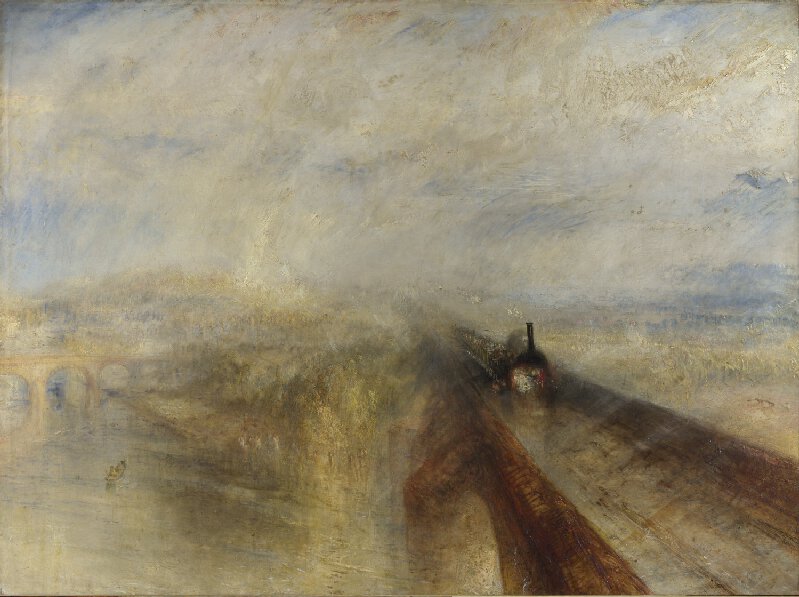
Isaiah 64.1-9: Rain, Steam, Speed

The words of the prophet Isaiah are featured the first three weeks of Advent in year B of the Revised Common Lectionary. For Advent 1B, the specific text is Isaiah 64:1-9. In this passage Isaiah prays that God will tear open the heavens, come down, and perform the awesome deeds for which God is known. Those awesome deeds seems more frightening than comforting: the ground shakes, nations tremble. The prophet offers the descriptive parallel of water made hot enough to boil. The combination might truly be terrifying.

Though it does not especially look like it, English painter J.M.W. Turner captured an experience that was literally as ground-shaking as the prophet calls for. The painting Rain, Steam, Speed captures a time when the railroad was changing England. Where development of cities and civilization had previously required access by navigable waters, the railroad made it possible for industry to develop in non-waterside locations. Goods and people could be transported by the railroad. But Turner gives the train more symbolism than that.
J.M.W. Turner. Rain, Steam, Speed. c. 1844. London: National Gallery. 
For Turner, the train tears through the landscape, a dark gash against blue and gold. The bridge and train separate a man in a boat on the river (to the left of the bridge) from a farmer plowing his field (to the right of the bridge). At the left is the increasingly irrelevant road bridge that crosses the river. The boat is powered by the man; the plowing is powered by the animals. The train, of course, is powered by steam. Small bits of red and white paint on the engine are not realistic - there was no way to see through to the engine's firebox. But those paint smudges symbolize the fire that burns, causing water to boil and turn to steam which is harnessed, powering the locomotive.

The train thunders across a bridge (traditionally identified as the Maidenhead railway bridge, across the Thames between Taplow and Maidenhead). Passengers sit in open-air cars behind the engine. They can feel the mist of the steam and the rain as they travel at 50 heart-stopping, breathtaking miles an hour.

O that you would tear open the heavens and come down. Mountains quaking, fire kindling, water boiling. And God's presence is known. Heart-stopping. Breathtaking.

You have hidden your face from us, and have delivered us into the hand of our iniquity.

One of the details that easily escapes notice in the painting is the rabbit. Yes, there is a rabbit. It is running directly in front of the train. What exactly does the hare mean? Is nature going to be vanquished - or at least forced to succumb to "progress"? Is technology about to run over the rabbit? Have we been delivered into the hand of our iniquity? Or is the rabbit still faster than the train? Can we see it as God working for those who wait for God?
Rain. Steam. Speed. Torn heavens and quaking earth. Kindled fire and boiling water. And the first Sunday as we wait for the God who is to come. Do not be exceedingly angry, O LORD, and do not remember iniquity forever. Now consider, we are all your people.


For thoughts on the gospel lesson for Advent 1B, click here.
For additional thoughts on the impact of steam and the earth, click here or on the Facebook link below.

Sunday, January 29, 2017

Isaiah 58.1-12: God's Choice

The Epiphany 5A reading from Hebrew scripture is pretty direct. Isaiah 58:1-12 is a conversation between God and the nation.
   God: Go ahead. Tell the people what is wrong with how they are living. They keep saying to me,    People: "We fast, but you aren't looking. Why should we humble ourselves if you aren't going to notice."
   God: You only fast so you can quarrel about it. That kind of fasting won't get my attention. Do you think that's the kind of fasting I want? The kind of fasting I want is this:
     loose the bonds of injustice
     untie the people who are yoked together...in fact, break all the yokes
     let the oppressed go free
     share your bread with the hungry
     bring the homeless into your homes
     clothe the naked
     Do those things. Then you'll have my attention.

Helen Siegl was born in Austria in 1924. She grew up in in Vienna during the years when National Socialism was on the rise in Germany and Austria was annexed by them. She was in Austria in the years of World War II and in the post-war years. Siegl immigrated to Canada, where she met and married Theodore Siegl. Theodore was named conservator of paintings at the Philadelphia Museum of Art, and the family, which would grow to include eight children, settled in Pennsylvania.
Helen Siegl. Isaiah 58:7. Block print. 
In the print here Siegl illustrates Isaiah 58:7. She includes the text of the verse and a depiction of the living out of that text. It's a direct illustration of a direct instruction from God. Get rid of pointing fingers and gossiping and burdening others, start feeding the hungry and help those who are in need. Then your lives will begin to shine like the sun at noon, then I'll be guiding you through the empty places, then you'll look like a garden. Then you will be called the repairer of all things: ancient ruins of the past, shaky foundations of the future. You'll make a place where people can live.

It is a pretty direct instruction. So if we don't do these things, then, to use the metaphor found in the gospel reading (Matthew 5:13) have we indeed lost our saltiness? And if we have lost that, then what are good for?

For thoughts on I Corinthians 2:1-16, click here.
For thoughts on salt (general thoughts, not necessarily about Matthew 5:13-20), click here.

Sunday, January 15, 2017

A Great Light

It's the line that echoes from the Isaiah passage (9:1-4) to the gospel reading (Matthew 4:12-23) on the second Sunday after Epiphany(A): The people who walked in [sat in] darkness have seen a great light.

I was all ready to bedazzle this blog post with some of the amazing light installations that contemporary artists are creating. Millions of lights created through actual lights and reflections in mirrored rooms. Images the size of a cathedral wall projected onto...a cathedral wall. Lights that change according to programmed pattern or random change. Clear lights. Colored lights.

And then I wondered if "great light" might mean something else entirely.

Perhaps the light wasn't great because it was a spectacular display of cosmic fireworks. Perhaps the light was great because of what happened by it.

After all, the pyramids of Giza, Gothic cathedrals, the rock churches of Lalibela - all of these were made at a time when the world was (to quote a book title) lit only by fire. Abraham Lincoln didn't learn to read by flipping on a light switch when he got back to the family cabin after working all day. Astronomers around the globe created maps of the heavens. They found those stars with a candle or lantern sitting on the work table next to their telescopes. Any nighttime construction at Stonehenge was done by torchlight. Even for Jesus, who might have been welcomed to earth with a cosmic light show, it wasn't a daily occurrence. And despite what artists might have you believe, there probably wasn't a disk of unnatural light around his head. Someone would have mentioned that. Jesus' life was lit by oil-fueled lanterns and fires.

What might happen, then, when we think about the "great light" that we have seen? Not the star that led magi, but Jesus. How might that great light move us, lead us, call us?

But I can't help myself, so check out the Art&Faith Matters Facebook page for just one of those light installations.

For other thoughts on Isaiah and Matthew, click here.

Sunday, December 11, 2016

Matthew 1.18-25: Joseph, Do Not Be Afraid

The tie between the Gospel reading and the reading from Hebrew scripture for Advent 4A is Matthew's quotation of the Isaiah reading: the young woman/virgin is with child/shall conceive and shall bear a son and (they) shall name him Emmanuel. (Isaiah 7:10-16/Matthew 1:18-25). The gospel writer quotes the prophet in order to reinforce the angel's assurance to Joseph in the minds and ears of the hearers. In the context of the gospel reading, the idea is presented in order to assure Joseph that he and Mary can be betrothed without any qualms.

Joseph is convinced by the angel's statement. So Joseph and Mary are engaged. Or betrothed. Or married.

It's an almost lost episode in the story. Luke gives the betrothal a couple of verses, but Matthew seems to let the angel's assurance imply that the ceremony (or ceremonies if betrothal and marriage are separated) occurs. Though not described in scripture, the subject is treated in art, usually with Mary and Joseph standing on either side of a church official. Mary's hand is outstretched and Joseph puts a ring on her finger. There is often an architectural setting - sometimes a quotation of the building in which the painting lives (as a means of making the scene more immediate and perhaps providing silent encouragement for all brides and grooms who are married in that church). In some versions the bride wears white; in others, she wears a red tunic with a blue cloak.
(Left) Raphael. The Marriage of the Virgin. 1504. Milan: Pinacoteca di Brera. http://pinacotecabrera.org/en/collezione-online/opere/the-marriage-of-the-virgin/  (Right) Tissot. The Betrothal of the Holy Virgin and Saint Joseph. 1886-1894. Brooklyn, NY: Brooklyn Museum. https://www.brooklynmuseum.org/opencollection/objects/4421
Both of the paintings above treat the subject of the marriage/betrothal of Mary and Joseph. Each is fabricated by the artist. Renaissance artist Raphael paints the holy couple standing in front of a central plan building reminiscent of Bramante's Tempietto in Rome, which was built in 1502. the building would have still be quite new when the painting was done in 1504. The composition employs severe one-point perspective and arranges the people in a semi-circle that echoes the architecture. The marriage ceremony seems to be less important in the composition that the artist's bravura demonstration of perspective. 

Tissot takes a completely different approach, concocting a scene filled with exotic detail that symbolizes the near eastern setting of the story. The bride and groom wear elaborately patterned garments and walk under a patterned canopy. Beneath their feet is a flower petal-strewn carpet. Sections of Roman (round) arches indicate the building in or near which the ceremony takes place.

In both images, there is a crowd and ceremony and onlookers and official blessing of this union. People are well-dressed and somber. Is this how you imagined the beginning of life together for this couple? What else is there to say about how artists have depicted this story? See  Art&Faith Matters' Facebook page. 

Sunday, December 4, 2016

Isaiah 35.1-10: The Sign of the Crocus

The wilderness and the dry land shall be glad, the desert shall rejoice and blossom; like the crocus it shall blossom abundantly, and rejoice with joy and singing. So says the prophet Isaiah in the reading from Hebrew scripture for Advent 3A (Isaiah 35:1-10).

Vincent Van Gogh. Basket of Crocus Bulbs. 1887. Amsterdam: Van Gogh Museum. https://www.vangoghmuseum.nl/en/collection/s0179V1962

The crocus is specifically mentioned in Isaiah as a result when the wilderness and dry land and desert rejoice. What would make a dry area like a desert rejoice? Rain. And that is indeed when crocuses appear in Israel.

The Winter Crocus (Crocus Hyemalis) grows after Israel's long, hot summer. It is among the earliest plants to bloom. The crocus isn't much of a sign as far as volume and height go. The plant is stemless and stands only 1"-3". Its value as a sign (and symbol) is in its ability to withstand the drought of summer and to sprout, sometimes in anticipation of the rain. When you see the crocus you know that the rains are coming. In an arid land, this is indeed a sign.

That's how it will be for the ransomed of the Lord who are returning to Israel. They are a sprout. There will be (re)building to do in the land. There will be land to be reclaimed. There is still work to do. But the sign - the small shoot of green - is there.

One of the questions we need to ask in this Advent season is whether we are able to see small green shoots for what they are. Are we so overwhelmed with a dry and arid landscape that we don't see - don't expect, don't even look for - the green shoots that are signs of return, renewal and the kingdom of God.

On Facebook this week: Van Gogh  mentions crocuses in a letter to his brother. To read it click here.
For thoughts on John in prison (Matthew 11:2-11), click here.

Sunday, November 27, 2016

Isaiah 11.1-10: How Peaceable?

It's hard to resist Isaiah's "Peaceable Kingdom" (Isaiah 11:1-10) when it shows up in the lectionary readings for Advent 2A. It appears to have been reasonably easy for artists to resist that scene for centuries, though. There are pictures and sculptures of lions. There are pictures and sculptures of lambs. There are very few images of lions lying down with lambs. The frequency of depictions of what became known as "The Peaceable Kingdom" increases after the eighteenth century.

The American artist most connected with the subject is a Quaker painter named Edward Hicks. Hicks painted the subject more than 60 times over the course of his artistic life. His original composition, painted around 1815 was based on an engraving by English artist Richard Westall. Over and over he painted the subject, perhaps in an effort to paint the peace into reality.

Because in reality, Hicks was not living in a peaceable place at all. In his paintings, there are inclusions of and allusions to the non-peaceable world in which he lived. Hicks shows us how hard it is to conjure Isaiah's vision when we live in the world that we do.

Hicks' earliest versions show a gentle child among animals that look like plush toys. We know that Isaiah includes predator and prey, eater and eaten, but in these earliest versions there seems to be more the sense of harmless animals than natural enemies who have decided to live together peaceably. These early images feature the young child who is leading them, carrying a length of grapevine on which hangs a cluster of grapes. The grapes should call to mind the promise of an abundant land. For what else would there be in the kingdom envisioned by Isaiah.

The second phase of Hicks' paintings draw a direct line between painting and scripture. Hicks' training was as a signmaker, so his inclusion of all or portions of Isaiah 11 are not unexpected. Not all versions with text have the same text, though originate in Isaiah. The versions with more text often use that additional text to explain the usual background scene. In that scene, Quaker William Penn makes a treaty with the Lenni Lenape (also known as the Delaware) people. This treaty, entered into in 1683, held until 1755. In the version shown here, the circle of treaty-makers is overshadowed by Virginia's Natural Bridge, which visually connects the two sides of the canvas.

In the "middle" Kingdoms, the animals become more aggressive. The lion's and leopard's teeth are visible in a couple of versions, and the animals become more tense. Their eyes are wide open, and they stare unblinkingly (hostilely?) from the painting. This increase in tension may be a reflection of the divisions happening in the Quaker community. In 1827 there occurred the "Great Separation" where so-called "Hicksite" (because they followed Elias Hicks, a cousin of the painter Edward Hicks) Quakers, who chose to emphasize the Inward Light as a source of guidance for faith and conscience, separated from the so-called "Orthodox" Quakers, who emphasized a more Protestant reliance on Biblical authority. Originating in Philadelphia Yearly Meeting, this division became wider and spread, causing painful separations in other meetings and among families. These divisions were especially painful for Hicks, who in addition to being a sign and coach painter was also a minister in the Middletown (PA) Yearly Meeting. There are a number of Hicks paintings that include a gnarled, dead tree in the background as a further sign of Hicks' understanding of the split among Quakers.

Compare the lion faces in the four versions shown here. Which lion goes with which painting? Can you put them in order? In the later Kingdoms the viewers' first impression of the animals is that they are neither plush nor attentive. They seem...tired. Dispirited, maybe. A career's worth of living on God's holy mountain seems to have taken a toll. Or maybe it's the non-peaceable kingdom in which the artist is living that has taken a toll on the artist.
Hicks helps us see the passage, but he was unable to live it in reality. We've not seen this come to pass either. But that doesn't mean it won't happen. The vision is memorable. The promise is certain. One day they will not hurt or destroy on all God's holy mountain. On a day that is still to come.

All paintings by Edward Hicks.
(Top). Peaceable Kingdom. 1816-1818. Cleveland, OH: Cleveland Museum of Art. http://www.clevelandart.org/art/1945.38
(Second from top). Peaceable Kingdom of the Branch. 1822-1825. Williamsburg, VA: Abby Aldrich Rockefeller Folk Art Center. http://emuseum.history.org/view/objects/asitem/search@/21/title-asc?t:state:flow=9c95172c-d3b7-456e-b906-de4cc96d9c1b
(Second from bottom). Peaceable Kingdom. c. 1833. Worcester, MA: Worcester Museum of Art. http://www.worcesterart.org/collection/American/1934.65.html
(Bottom) Peaceable Kingdom. 1844. Williamsburg, VA: Abby Aldrich Rockefeller Folk Art Center. http://emuseum.history.org/view/objects/asitem/search@/20/title-asc?t:state:flow=9c95172c-d3b7-456e-b906-de4cc96d9c1b


See what this leopard brings to the discussion. See Art&Faith Matters on Facebook.

Sunday, November 20, 2016

Isaiah 2.3: Of Swords and Plowshares

Has there been a time since the words were written that humanity hasn't longed for the actualization of Isaiah 2:3 (part of the reading from Hebrew scripture for Advent 1A)? Surely we do now. Imagine a world where nation did not lift up sword against nation. To this point in human history, though, it seems that beating swords into plowshares is an episodic happening rather than an eternally established reality.

American artist Winslow Homer understood the cost of war. He was in his mid-twenties when the Civil War broke out. Though he did not serve in the army, he was a "special artist" for Harper's Weekly magazine and, as such, moved in and among the armies and battle lines during the war. For almost two months in 1861 he traveled with George McClellan's Army of the Potomac through Virginia.

Homer created a large oil painting that illustrates rather than preaches Isaiah's vision of a time when the tools of war are traded for tools of agriculture. The artist worked on the painting for several months after the war was over. Abraham Lincoln had been assassinated and the nation was working its way toward again being "united" states. Homer places an anonymous veteran in an actual field. A Union Army jacket is discarded in the lower right corner along with a canteen. The jacket has been abandoned presumably because the heat of the day and the exertion of the work makes a jacket unnecessary. But it is also the truth that this farmer has abandoned his military occupation and returned to his farm - he has traded the battlefield for the wheatfield. Hence the title of the painting.
Winslow Homer. The Veteran in a New Field. 1865. NY: Metropolitan Museum of Art. http://www.metmuseum.org/toah/works-of-art/67.187.131/
Judging by the painting, the plows have done their work well. The 1865 wheat crop is documented to have been a bumper crop. Homer shows grain heads almost at the height of the farmer's head. One might see in this painting a positive outlook for the farmer and the nation. But there is a darker side.

The farmer is harvesting wheat with a single-bladed scythe, a tool that was already out of date by 1865. Farmers of that time would have used a grain cradle or cradle scythe to harvest. Homer chose the older implement because of its association with the Grim Reaper. While Homer's veteran has moved on, both he and the viewer would have, in this scene, been reminded of the cost of war. Many of the bloodiest battles of the war were fought in fields, so fields had become associated with soldiers who were cut down and had fallen in the same way that this farmer now cuts and fells the wheat. Timothy O'Sullivan's photograph "Harvest of Death" shows the aftermath of the Battle of Gettysburg.

Isaiah's vision would have been as appealing to a 19th-century audience as it is to us today. Imagine. Nation shall not lift up sword against nation. Neither shall they learn war anymore.

Come, Lord Jesus.

Sunday, May 15, 2016

Proverbs 8.1-4, 22-31: Holy Wisdom

By Trinity Sunday, Christ has ascended and the Holy Spirit has descended. The disciples have preached and thousands have been baptized. And with Trinity C's reading from Hebrew scripture (Proverbs 8:1-4, 22-31) we find ourselves back at the beginning. The very beginning. Creation. At the beginning, God drew a circle on the face of the deep, and Wisdom was there.


The structure pictured here is Hagia Sophia in Istanbul, Turkey. It is now a museum. Before that it was a mosque. But at its construction it was a Christian church. Hagia Sophia. Which is not a reference to St. Sophia. The official name is Ναός τῆς Ἁγίας τοῦ Θεοῦ Σοφίας, Naos tēs Hagias tou Theou Sophias, "Shrine of the Holy Wisdom of God."

The Wisdom tradition in Hebrew scripture explores the idea of wisdom: who is wise, what it means to be wise. When writing to the Corinthians, Paul refers to Jesus Christ as the wisdom of God (I Corinthians 1:24). The church of Holy Wisdom (sophia) honors Jesus as divine wisdom. In the Divine Liturgy, the Gospel Book is brought into the center of worship and lifted up by the priest as he exclaims, "Wisdom!" The people reply, "Come, let us worship and bow before Christ." Christ is the wisdom.

One of the mosaics in Hagia Sophia (left, bottom) shows Byzantine emperor Leo VI (called "the Wise") bowing before an enthroned Christ. The mosaic is located in the tympanum over the Imperial Door in Hagia Sophia - the door used only by the emperor. On the left of Christ is his mother Mary, the Theotokos. On the eve of feasts of the Theotokos, one of the traditional readings is Proverbs 9:11. (see more about this on Art&Faith Matters' Facebook page), which ties Mary to Wisdom. In the mosaic to the right of Jesus is an angelic figure. The figure is identified sometimes as the archangel Gabriel, sometimes as the Angel of Great Counsel. "Angel of Great Counsel" (alternatively "Messenger of Great Counsel") is how the Septuagint translates the phrase in Isaiah 9:6, which the NRSV translates as "Wonderful Counselor." Christians read that verse during Advent with its reference to a child who has been born for us and a son who has been given to us. Again, Christ is associated with wisdom - great counsel.

The current structure, which is neither the first on the site nor the first called Hagia Sophia, was built between 532 and 537. Justinian I, Byzantine emperor, charged Isidore and Anthemius with the design and construction of the building, which features a dome that rises 180 feet above the floor. The dome rests on four piers, which transfers the weight of the dome through a series of smaller outer domes. The cathedral was the first great work of Byzantine architecture. For more about the church, see: http://www.sacred-destinations.com/turkey/istanbul-hagia-sophia

In verse 30 of Proverbs 8, the Hebrew word אָ֫מ֥וֹן is variously translated. One approach relates that word to the noun אומן, which means artisan or architect. In that translation, Wisdom is the architect at God's side as the earth is being created. Holy Wisdom is the architect. Holy Wisdom is also the architecture.

For thoughts on Trinity Sunday, click here.

Sunday, November 29, 2015

Luke 3.1-6: Build a Road

The language is that of road-building, though Luke left that part out when quoting the prophet. In the gospel reading for Advent 2C (Luke 3:1-6), Luke says: ...as it is written in the book of the words of the prophet Isaiah, “The voice of one crying out in the wilderness: ‘Prepare the way of the Lord, make his paths straight. Every valley shall be filled, and every mountain and hill shall be made low, and the crooked shall be made straight, and the rough ways made smooth; and all flesh shall see the salvation of God.’” The "original" is: A voice cries out: ‘In the wilderness prepare the way of the Lord, make straight in the desert a highway for our God. Every valley shall be lifted up, and every mountain and hill be made low; the uneven ground shall become level, and the rough places a plain. Then the glory of the Lord shall be revealed, and all people shall see it together, for the mouth of the Lord has spoken.’ (Isaiah 40:3-5)

Building roads today may be perceived as easier because of the technological and engineering advances. But, then, along with the engineering advances, the expectations have also risen. Today it isn't enough to carve out a passable track over the natural ridge configuration of a mountain; instead, the mountain must be dynamited out of the way and a more level roadbed laid.

To be sure, the point of the prophetic passage is that the people understand that God is about to (re)enter their lives and a way must be made for that. In the case of Jesus, God will make the way with the incarnation. But the metaphor is that of a road. And roads, whether by God or by humans, must still be built.

A part of the backbreaking process of 19th-century road construction is captured by Gustave Courbet in his work The Stonebreakers. Courbet, a French artist, established Realism as an anti-academic approach to art in the middle of the 19th century. The picture, treated harshly by many contemporary critics, shows two figures engaged in clearing stones from roadbeds and then breaking them into smaller pieces. The stones were turned into gravel for paving material and other uses.
Gustave Courbet. The Stonebreakers. 1849. Destroyed 1945. Previously Gemaldegalerie, Dresden, Germany.
The two figures are anonymous. We would not be able to recognize either of the two workers should we see them again, but they seem by turns too young and too old to be doing this demanding work. The artist saw the two workers at their task as he was riding in his carriage into the countryside to paint a landscape and was struck by their suitability as a painting subject. He invited them to his studio the following day and began the painting.

Realism refused to idealize any subject, so there is no golden glow of daylight or oneness with nature. There is only work. Pull, swing, chop, load, carry, dump, start over.

Philosopher Pierre-Joseph Proudhon, a friend of Courbet's, wrote of this painting: “Our industrial civilization which everyday invents marvelous machines to labour – to sow, spin, in short to execute all sorts of jobs, is yet incapable of liberating the human being from the grossest, the most repugnant and painful of tasks – the lamentable lot of the poor.”

Though civilization may not have been able to liberate the poor from their "lamentable lot", the coming of Christ was to accomplish just that. And these two workers, one too young, one too old, disregarded by society, certainly among "the least of these", would have been right at home in Luke's gospel with its babies born to women who were too old and too young, with its working shepherds who were unlikely attendees at the manger, with its "blessed are the poor."

Prepare the way of the Lord.


Heeeeere's Malachi! Click on the Facebook link to find out which of these figures is Malachi and what he is doing in this altarpiece.

For other thoughts on Malachi 3:1-4, click here.