Showing posts with label Palm Sunday. Show all posts

Sunday, March 22, 2020

Palm Sunday: Putting It Together

For additional Palm Sunday links, click on the "Liturgical Calendar" tab above.

I suppose everything is seen through the coronavirus these days. As Christians turn their faces toward Holy Week the question is whether anything can be salvaged. The re-enactments of children waving palm branches. Gathering around tables to share a meal. Tenebrae services in gradually darkening rooms. Easter vigils that retell the story of salvation. Knocking on doors and striking new fire and processing into a sanctuary. How will that happen this year?

The art of Holy Week is often smooth and technically polished. Fresco artists of the 14th and 15th centuries carefully and smoothly mixed dry pigments with water and painted it on fresh plaster to illustrate the stories of scripture on the walls of churches and chapels. Baroque artists boldly brushed oil paint onto canvas, creating dramatic scenes of light and dark. Stained glass windows have carefully cut pieces of glass in lead channels, defining colors and values. People are defined. Branches are defined. The donkey is defined. Everything is in its designated place.

That's usually how our church services are as well. Children are rehearsed before being given a branch and scooted down the center aisle. Familiar hymns are rehearsed by the choir and soloists. Candles are lined up and snuffers are located. Everything needs to be, if not perfect, then as perfect as we can make it.

But not this year. This year we're trying to figure out how to craft a service of worship when worshipers are virtually together rather than sharing physical space. How to put together "what we've always done" with "we've never done this before." It's going to be a combination of new and old, familiar and strange, well-practiced and first-run.

Romare Bearden's collage "Palm Sunday Procession" may be a better image for us this year than all the perfect oil paintings and frescoes of the past. Bearden has used paint and a variety of papers. There are cut edges and torn edges. There are areas of flat color and parts that appear to be photocopies or interpretations of drawings sourced from mosaics or Early Christian wall paintings. The people in procession have varying skin tones, and there are adults as well as a child being carried. There are a lot of moving parts.
Romare Bearden. Palm Sunday Procession. 1967-1968. 56 x 44 in. 
Hood Museum of Art, Dartmouth College. Hanover, NH.
The composition has unity because of the artist. The skill and instinct of the artist brings together the pieces of paper no matter the source or the edge. It's the artist who makes this laundry list of components work as a single unit. It is the artist who helps us see the procession of Palm Sunday in a different way: not as a monolithic assemblage of perfectly constructed people in clothes of coordinating colors frozen in time, but as a collection of individual people made up of individual parts who have gathered to shout, "Hosanna! Save us!"

Bearden's original collages are no more than 14" x 18." These original collages were photographed and enlarged to six by eight feet or, as here, four by five feet. Those torn edges and purposefully mismatched papers were magnified four, five, or six times their original size in an effort to give the subjects a monumentality they did not have in their original size.

That may be a message to us as well. At that scale we again see how the hand and eye of the artist have combined the seemingly potluck ingredients into a whole. This week, put it all together. Print it large, embracing the torn edges and the variety of colors and sources. Trust the artist to make it work.

Sunday, April 7, 2019

Palm Sunday: The Palmesel

If you want to re-enact Jesus' entry into Jerusalem, you'll need a few things. Some people wearing cloaks...so they can take them off and lay them on the road. Some palm branches (well, maybe...see this week's Facebook post for more on that). Jesus on a donkey.

Fortunately, German sculptural tradition provided the last through a form called a palmesel (palm donkey). The figure of Jesus, usually about half life-size, is seated on the donkey, and the sculptural group is on a wheeled platform pulled through a town or city as part of Palm Sunday processions. Townspeople spread their cloaks, along with palm branches, on the ground before the Palmesel. Just like they did in the gospel accounts.
 (Left) Dominikus Debler. Der Palmesel Debler IX, 491 (S. 113). c. 1800. Die Chronik des Dominikus Debler. 1756-1836. Schwäbisch Gmünd.  (right) Palmesel. 15th century. 61 1/2 x 23 3/4 x 54 1/2 in.NY: Metropolitan Museum of Art (Cloisters Collection). 

You can see a short film about a contemporary Palm Sunday procession through two towns in Austria that incorporates a palmesel here. 


This week on Art&Faith Matters on Facebook, one more thing you need for a re-enactment of Jesus' triumphal entry into Jerusalem. 
For Psalm 118:19-29, click here
For Luke 19:28-40, click here
For Matthew 21:1-11, click here.
For Palm/Passion Sunday, click here. 

Sunday, March 18, 2018

Psalm 118.19-29: Come On In

Open to me the gates of righteousness, that I may enter through them and give thanks to the LORD. This is the gate of the LORD; the righteous shall enter through it. (Psalm 118:19-20, Liturgy of the Palms)

Do you even pay attention when you walk through the door of your church? Do you mark the transition? Or are you focused on the people you need to talk to, the Sunday School lesson you need to review, the youth activities that are happening after worship? Do you walk into the church building thinking, "This is the gate of the Lord"? Do you imagine that you are making a triumphal entry?

You were meant to think just that when walking into medieval cathedrals. The large, ornate doors (usually at the west end of the cathedral, opposite the apse where the altar is located) were meant to be the gateways to heaven. To enter the building was to be taken away from earth and transported to heaven. But to get there, worshipers were required to walk through the door, the gate. 

The Roman triumphal arch was designed to commemorate the victories of Roman emperors (top photo, Arch of Titus, Rome). The western church incorporated that form into the apse of basilica-plan churches (second photo from top, S. Apollinare in Classe, Ravenna). The triumphal arch stretched over the altar, where Christ's sacrifice is made. Behind the arch was a half-dome. The dome, any dome, symbolizes heaven. The triumphal arch motif in this place reinterprets the understanding of "triumph". For Christians there is triumph in Christ's death and resurrection.

The Roman single-arch structure was further adapted into a three-arch design (third photo from top, Arch of Constantine, Rome). The three-arch triumphal motif was then applied to the front of the cathedrals (bottom photo, west facade, Amiens Cathedral, France). Though Amiens' facade is in the Gothic style (with pointed arches rather than round Roman arches) its larger center arch and smaller side arches echoes Constantine's arch. Do you think that medieval worshipers remembered the idea of triumph as they came to worship? Does the three emperor-inspired arches give us the sense of Jesus' entry into Jerusalem - the entry we call "triumphal". 

One last detail ties Psalm 118 to our cathedral portals: the tympanum sculpture over the center door. Christ sits in majesty over the middle door. This is the gate of the Lord, the psalmist says. The righteous shall enter through it. In the Amiens Cathedral tympanum Christ sits enthroned above the door, judging who is righteous enough to enter through it. 

For worshipers standing at that door, at that portal, this is the gate of the Lord. And the righteous shall enter through it. Blessed is the one who comes in the name of the Lord.

For additional discussion about a triumphal entry, click here.
For additional thoughts on the donkey, click here.
For additional thoughts on the palms, click here.
For thoughts on the rejected cornerstone (118:22), click here.
The entry into Jerusalem on a sarcophagus? See Art&Faith Matters' Facebook page.

Sunday, April 2, 2017

Matthew 21.1-11: Carried and Waved

The re-enactment of Christ's entry into Jerusalem is an annual event around the world. With palm branches (or some kind of branches) in evidence, Christ's church remembers that Jesus came riding into the city on a donkey and a colt, according to the Gospel reading for Palm/Passion Sunday in lectionary year A (Matthew 21:1-11). Matthew's gospel gives us the donkey and the colt, branches being spread on the road (but not waved) and cries of Hosanna!

It is customary that the palms from one year are kept until the following year when the year-old bone-dry palms are burned to create the ashes imposed on the faithful on Ash Wednesday. The palm branches become the symbol of dust from which we came and to which we will return. The practice reminds us that the people's cries of Hosanna! on Sunday will turn to shouts of Crucify him! on Friday. Inconstancy is an eternally human characteristic.

It is this journey from palm to ash as a reminder of sin that makes the photo below especially interesting. The photo was taken as part of an assignment to document Palm Sunday celebrations around the world. These three women sit at a bus stop in Warsaw, Poland, with palm branches taller than they are. Perhaps the photographer was intrigued with the scale of woman to branch or the contrast of the red scarf with the green branch. Maybe it was the sheer ordinariness of the women's postures. The photo would be perfectly ordinary if the palms were edited out of the picture. The women seem almost unaware that they are holding something the height of a small tree.
Alik Keplicz/AP. Women with palm leaves wait at a bus stop after a Palm Sunday procession in Warsaw, Poland, on March 20, 2016. http://www.nbcnews.com/slideshow/christians-celebrate-palm-sunday-starting-holy-week-n542286
Do you think the women are on their way to the procession or on their way home? It doesn't matter, of course, but to see them carrying giant palm fronds in such an ordinary setting might kindle some questions. If we consider the palms as symbols of the human inconstancy (frailty? finitude?) that becomes the sin of demanding the death of an innocent man, then these women give us opportunities to consider: the original branch-bearers carried their inconstancy with them to the Jesus parade and on that day they also carried their inconstancy back home.

On this Sunday of palms and parades, may we remember all the ways that we, too, carefully bring our own frailty, finitude and inconstancy to the places we see Jesus. How often is our inconstancy exhibited in how we live our lives, even in times when we shout "Save us!" And Jesus rides on.

For additional thoughts on Palm Sunday's "triumphal" entry, click here.
For additional thoughts on Palm Sunday's donkey, click here.

Sunday, March 13, 2016

Luke 19.28-40: The Donkey

We have seen a donkey before in the story of Jesus. Long before we get to Palm/Passion Sunday (Luke 19:28-40 or John 12:12-16), the donkey has played a vital role in the life of Jesus. In the Christmas song/poem "The Friendly Beasts", we read this stanza:
"I," said the donkey, shaggy and brown,/"I carried His mother up hill and down;
I carried her safely to Bethlehem town."/ "I," said the donkey, shaggy and brown.

And here we are again. Another donkey. This time bearing Jesus through Jerusalem. Cheering crowds line the street. Cloaks are spread and branches waved. And the "vehicle" that made it possible was the donkey who carried Jesus in fulfillment of scripture. Was it a party atmosphere? Was it a solemn occasion? Two very different pieces of art paint two very different events...and two very different donkeys.

Hippolyte Flandrin's nineteenth-century painting of the subject shows a very balanced, almost rigid event. Strong horizontals (the road, the top of the crowd of heads, the city architecture) are perpendicularly counterpointed by strong verticals (Jesus' body, the crowd of people mostly standing upright, the palm branches, the vertical lines of the city wall). There is balance and measure. It is hard to imagine this crowd shouting anything as they stand so politely, watching Jesus ride by.

The donkey echoes that balance with strong vertical lines (legs) and strong horizontal lines (back). Accompanied by the colt, the donkey walks in measured step. The pace is surely slow. Jesus stares directly ahead, focused on the future. Surely his mind is filled with understanding of what he is riding toward.
Jean-Hippolyte Flandrin. Christ's Entry into Jerusalem.c. 1842.  Fresco. Paris: Church of St. Germain des Pres.
Information on St. Germain des Pres at: http://www.preservesaintgermain.org/
Which is why the manuscript illumination below offers such a contrast. Where Flandrin's understanding of Christ's entry into Jerusalem is one of balance and measure, the illustrator of the Armenian gospel book uses curves and contrast. The colors of the illustration are vivid and saturated. The vertical lines of architecture are minimized, and the vegetation is made of wavy, curvy lines in the leaves and branches and trunks. Even the ferns growing at the base of the center tree have curved ribs and fronds. Garment fabric collects in curves and falls in folds. One young parade-goer is spreading his garment in the street...and it isn't an outer garment. It's the whole outfit! People are waving, and hands are clapping. Complementary colors (red and green, especially) add visual life to the scene. Very unlike Flandrin's version.
Entry of Jesus into Jerusalem, miniature from Armenian gospel, folio 7 verso. Armenian Museum, Isfahan, Iran.
But it may be the donkey that is the most different in the two versions. In the manuscript illumination, Jesus - riding sidesaddle - is on a bucking bronco of a donkey. All four of the donkey's feet have left the ground. The placement of the tree and the donkey with all four feet off the ground might even bring to mind a carousel horse (thanks to my friend Amy for that insight...and check the Art&Faith Matters FB page later in the week for more information on that).

The top line of the donkey's form creates a C-curve. The front two legs are also C-curves while the back legs are double-curved. The idea of the Messiah entering Jerusalem riding a donkey may have been foretold in scripture, but it appears that no one asked this particular donkey! Jesus, of course, is up to the challenge. He gives an almost "Look, Ma, no hands!" gesture (not that there are any reins in sight, to be honest). And how would you describe the expression on Jesus' face? It is a completely different picture of the events of the day.

Perhaps you've never considered that Jesus had this kind of ride through Jerusalem. I hadn't before seeing this picture. I had always imagined that the animal carrying Jesus did so with the decorum appropriate to his rider. But maybe not. Perhaps the bucking donkey with a mind of its own helped Jesus remember the stubborn, willful people for whom he came to earth in the first place.

For additional thoughts on Jesus' "triumphal" entry, click here.
For additional thoughts on the palms, click here.

Sunday, March 22, 2015

Palm/Passion Sunday: Triumphal?

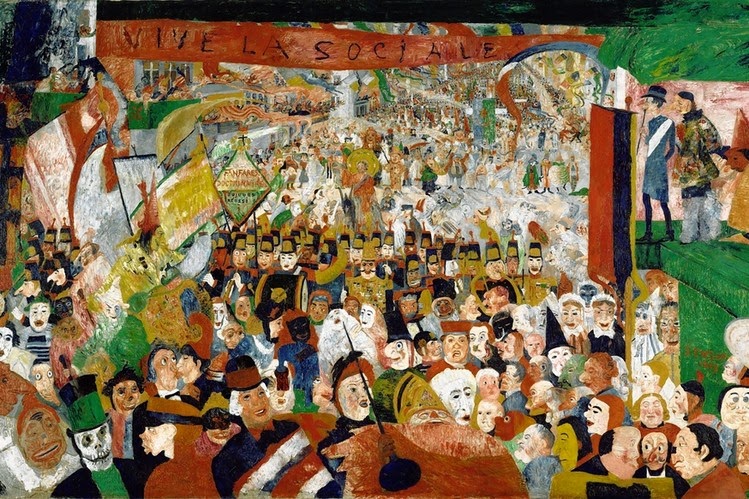
Plenty of artists have painted the events of what Christians call Palm Sunday (or Passion Sunday). There is usually some kind of urban architectural background. There are throngs of people. There is a donkey. The atmosphere is festive, the air filled with excitement.

Belgian artist James Ensor painted all those things: a city, a crowd, Jesus riding a donkey. But this isn't exactly what you might be used to seeing. Perhaps the skeleton wearing the top hat is different. Perhaps it's the clowns wearing masks. Maybe the oddest thing is the "Viva La Sociale" banner stretched across the roadway. Maybe it's that Jesus is barely distinguishable among the crowd.
Painting in the collection of the Getty Museum: http://www.getty.edu/art/collection/objects/811/james-ensor-christ%27s-entry-into-brussels-in-1889-belgian-1888/
The painting is titled Christ's Entry into Brussels in 1889. James Ensor painted the wall-sized work (slightly larger than 8' x 14') in 1888. In this work, Christ appears to be in the middle of a carnival parade. Characters abound, activity is everywhere, color riots. And no one appears to be giving Jesus any consideration.
Ensor probably saw himself a little bit like Jesus in this picture - alone in the middle of a crowd. Ensor was a founding member of Les XX (Les Vingt), but this painting was deemed too radical when Ensor submitted it to an exhibition. His style - quite modern in thought - was wildly different from the softer landscapes of the French Impressionists that had been occupying the leading edge of avant-garde art. His colors are much sharper than most of the Impressionists, and where they (and even Seurat and the Neo-Impressionists) used dots and dabs of color, Ensor appears to have broadly slathered on the paint with a palette knife. Undeterred by the lack of acceptance by the wider art community, Ensor was committed to the painting, displaying it prominently in his residence.

How might our observance of Palm Sunday/Passion Sunday be different this year, if we take our lead from this painting? What might we watch for? What might we do differently? What might we work to avoid?


Where did Jesus enter Jerusalem, according to tradition? See the Art&Faith Matters Facebook page to find out. 

For Psalm 118:19-29, click here
For Luke 19:28-40, click here
For Matthew 21:1-11, click here.