Showing posts with label Luke. Show all posts

Sunday, May 17, 2020

Luke and Acts: Something Promised This Way Comes

In the liturgical calendar, May 31, 2020 is both the celebration of Pentecost (Acts 2:1-21) and the day marking the Visitation of Mary and Elizabeth (Luke 1:39-57). It's an interesting mix. Both are important in their own right, but it's an interesting idea to consider them together. What do these days have to say to one another?

One episode is at the beginning of Jesus' story; the other is at the end. Jesus is present in both stories in a spiritual sense but not walking the earth in either story. Mary, the mother of Jesus may be present in both stories. Though Acts doesn't mention her presence, artists often depict Mary in the midst of  the disciples on the day of Pentecost. The Holy Spirit is also physically present at Pentecost and was also active in the early stories in Luke's gospel.

What both episodes recognize is a promise fulfilled. At the Visitation, Elizabeth rejoices that that "the mother of my Lord" comes to her. Elizabeth recognizes that the promise of the Messiah has come. She also recognizes Mary's faithfulness in believing the promise: And blessed is she who believed that there would be a fulfillment of what was spoken to her by the Lord. Pentecost is the fulfillment of the promised Spirit.
Jyoti Sahi. The Pentecost.1983.
Jyoti Sahi draws the stories together in the painting above. In the middle of the flame-like colors of Pentecost and under a descending dove is Mary, the mother of Jesus. Mary appears to be seated. Where you would expect to see her midsection clothed in white, however, is a mandorla. Mandorla is the Italian word for almond, which describes that seed-like shape. The shape is also called a vesica piscis. In images of the Visitation, Mary's belly is often defined by a shape that is at least reminiscent of the mandorla. Within that shape is Jesus (and in the example linked here, check John's reaction). The mandorla in the painting reminds us that Mary is the mother of Jesus the Christ. Because it is an image of Pentecost, we remember that the church is called to be the body of Christ in the world. 

Pentecost is the seed of the church. The promised power has come. It's not the first of God's promises that have been fulfilled. One more time, the fulfilled promise of God means life and growth. We should all be leaping for joy.  

Sunday, September 1, 2019

Luke 15.1-10: Two

Which one of you, having a hundred sheep and losing one of them, does not leave the ninety-nine in the wilderness and go after the one that is lost until he finds it? (Luke 15:1-10) Images that incorporate this text usually show just that. One sheep down in a ravine with a shepherd hovering close by, reaching down with a crooked shepherd's staff ready to crook the handle around the sheep's neck and pull it up to the ledge where the shepherd is waiting. So it is with the two paintings here. Neither moves beyond illustration of the setting of the story: shepherd, staff, sheep, clouds in sky, mountain, reaching.

It is when the two paintings get together that something interesting becomes apparent. What do you see?
(Left) Unable to identify artist or collection of this painting. Please email if you can help. 
(Right) Alford U. Soord. The Lost Sheep. Many different versions (including prints) of this painting exist. 
One version is at the Church of St. Barnabas, Homerton, East London.
Though some things are similar, two differences emerge. One is the depiction of the sheep. In the image on the left, the sheep is black, perpetuating the symbolism of the sinner as a "black sheep." The Soord painting does not include that stereotype.

That one lost sheep...how obvious is that sheep? Does the "lostness" show up on the outside of the animal in addition to the sheep physically being absent? Does the stereotype want us to imagine the shepherd finally finding the lost sheep and exasperatedly saying, "I might have known that you would be the lost one"? 

The second difference is the point of view. In Soord's painting we are looking over the shoulder of the shepherd. We see past the shepherd across the seemingly bottomless valley to the mountains beyond, seeing the bird flying in the the space in between. In the painting on the left, we are parallel not to the shepherd but to the sheep. We are looking up into the face of the shepherd. 

That point of view offers us the thought that perhaps there was another lost sheep. And maybe that other lost sheep...is us.

For thoughts on the lost coins, click here
For another look at found sheep, see Art&Faith Matters on Facebook.

Sunday, July 21, 2019

Luke 12.32-40: Napping

Be dressed for action and have your lamps lit. Be those who are waiting for their master to return from the wedding banquet, so that they may open the door for him as soon as he comes and knocks. Blessed are those slaves whom the master finds alert when he comes. You also must be ready, for the Son of Man is coming at an unexpected hour. All are sentiments expressed in the gospel reading for Proper 14C/Ordinary 19C (Luke 12:32-40). All emphasize the need to be awake, watchful, alert. This is not the only text that bids Christians to stay awake.

But who of us doesn't enjoy a nap? My father believed that there was no such thing as a bad nap...just one that was too short.
Nicolaes Maes. Dame agee assoupie (Old Woman Dozing). c. 1655. Brussels: Musees Royaux des Beaux-Arts. 
Nicolaes Maes was fond of the subject of dozing women. He painted the subject more than once and more than once used this woman as his model. Because she appears in several paintings, some historians speculate that the model was, perhaps, the artist's mother. She is peacefully napping, having set aside her lacemaking as well as the book in her lap and the open Bible on the table. I would hope we would not begrudge this woman an afternoon nap. 

Maes stands in the same tradition that produced the still life/vanitas pictures, so we can find clues to an additional meaning by putting together the elements the artist has included in the picture. First, the abandoned lacemaking has moved the woman from industry and productivity to idleness. The Bible is open to Amos, a prophet who warned that when the nation failed to follow God's moral commandments, then the relationship between God and people was in danger of being dissolved. On the table an hourglass reminds the viewer that time is running out, especially for this older woman. She should be more industrious, especially as she will (presumably) be meeting her maker sooner rather than later and be called to account for her life on earth. Napping in the daytime is at least a waste of time and could be considered sinful. 

Where we might understand napping as a "battery recharge," her nap seems to symbolize sloth. Is napping as bad as all that? Certainly she does not embody the alertness called for in the gospel reading. Should the thief (or Jesus) choose this moment to come into her home, she will no doubt miss the entire thing. 

Sunday, June 23, 2019

Luke 9.51-62: Where You're Looking

Most state DMVs will tell you the same story: drivers tend to steer in the direction they are looking. If the driver's eyes move to the right, they will subconsciously turn the wheel to the right. Same is true for the left. We tend to go in the direction we are looking. So when Jesus' face is set to go to Jerusalem, well, that's where he is going (Luke 9:51-62). Nothing will stop him...not even the knowledge of what will happen in Jerusalem.
Thomas Hart Benton, Planting (Spring Plowing), 1939, lithograph on paper mounted on paperboard. 
Smithsonian American Art Museum.
So imagine if you are plowing a field. You walk along behind the horse or ox or mule and hold on to the plow. What do you think happens if you let your eyes drift off to the right. Yep, your plow will begin to drift to the right because subconsciously you'll pull the horses to the right.

No one who puts a hand to the plow and looks back is fit for the kingdom of God. If you're looking away from the kingdom of God, then you're going to drift away from the kingdom of God. The American Civil Rights Movement song had it right:
                                                     I got my hand on the gospel plow
                                                     Won't take nothing for my journey now
                                                     Keep your eyes on the prize, hold on.
                                                     (lyrics attributed to Alice Wine)

This week on Facebook, a look at another part of Jesus' comments in Luke 9:51-62.

For thoughts on II Kings 2:1-12, click here or here.

Sunday, June 16, 2019

Luke 8.26-39: A Scene So Terrible

The people were unable to bear the sight (Luke 8:26-39). In the context of this story of healing - where Jesus made whole the man who had been possessed by a "Legion" of demon spirits, this was the moment that the people just could not handle. It was a scene that might have looked like the one below.
Domenico Morelli. Pater Noster, the Sermon on the Mount. c. 1895. 
It seems strange that in this gospel episode a scene like this (people sitting around talking) should be the horrifying scene. The people were quite comfortable when the man was naked and living in the local cemetery. They were fine when he was ritually unclean. Fine when a herd of pigs ran themselves, probably squealing all the way, down the bank into water where they no doubt thrashed around until they were all dead and floating on the lake. Nope. That was all ok.

What they couldn't handle was health. They couldn't deal with a man now in his right mind, sitting calmly, talking with Jesus. Think about that. It was when Jesus brought health and healing that the people became afraid and demanded Jesus leave. What is wrong with these people? And what is wrong with us when we are fine with someone else's oppression, someone else's exploitation, someone else's failure, but we are afraid of someone else's wholeness, someone else's security, someone else's opportunity?

Note: The illustration above is of the sermon on the mount because as far as I know, there are no works that imagine the post-healing part of the story.

This week on Facebook, a look at the really disturbing scenes of Luke 8:26-39. Click here.

For thoughts on I Kings 21:1-15a, click here.

Sunday, February 17, 2019

Luke 6.27-38: It's Self-Explanatory

There isn't anything hidden or symbolic or metaphorical about Luke 6:27-38. It's self-explanatory. Love your enemies. Pray for those who persecute you. Do unto others as you would have them do unto you.
Norman Rockwell (1894-1978), Golden Rule, 1961. Oil on canvas, 44 1/2” x 39 1/2”. 
Stockbridge, MA: Norman Rockwell Museum Collections.
Norman Rockwell, known for his detailed, literal illustrations, is just the artist for this text. Because there's nothing metaphorical or symbolic about it.

It's just hard.

But it's never been more important than it is right now.


This week on Art&Faith Matters on Facebook...a duel for the liturgical year.

Sunday, February 10, 2019

Luke 6.17-26: Jesus Makes a Point

Did he preach standing on the side of a mountain? Was it on a flat piece of ground? The gospel writers differ, but in each case the meat of Jesus' sermon includes what we call the Beatitudes (Luke 6:17-26). The Beatitudes remind us of who is blessed (makarios can also be translated "greatly honored") in God's realm and who faces woe when that realm comes.

Jesus' phrases are familiar, but trying to capture all of his words leaves most artists with a generic scene of Jesus surrounded by disciples and crowds. In many of the images Jesus is making a widely-recognized oratorical gesture. His arm is raised and his index finger is pointed upward. You can see Socrates, Socrates again, even a toga-clad George Washington making the same gesture. It is a gesture designed to call attention to a particular point being made by the speaker.

In the work shown here, Jesus' disciples are gathered around him along with a crowd of people. In a soft golden light, a backlit Jesus sits but has raised his right arm. His finger points upward, echoing the gesture of Socrates and George Washington.


 At what point do you think this is? What is the point of the sermon where Jesus raises his right hand to emphasize his point? Surely he did not hold up that hand through the entire sermon. Is he emphasizing that the poor (the reading is from Luke's gospel, after all) to whom the kingdom of God belongs. Or perhaps he is emphasizing the woes to come for those who are full or for those who are laughing. What do you think is the most important part of the sermon? Or even the most important of the Beatitudes? What is Jesus' point?

The painting shown here is attributed to Gustave Dore online, but I'm unable to find a collection source that offers definitive information. You might look at other paintings of Jesus preaching this sermon and survey the many different hand gestures. Which ones are inviting? Which ones are forbidding? Are there some that seem to show uncertainty? Can those body language cues give you a way to interpret the entire sermon?


This week on Art&Faith Matters on Facebook...destination preaching! Click here.

Sunday, January 20, 2019

Luke 4:14-21 and Nehemiah 8: Read Aloud

Do you read aloud? Do you listen to the written word being read aloud? The rising popularity of audiobooks and podcasts seem to say that humans still respond to words spoken aloud, even in this culture of images. In both readings from scripture (Luke 4:14-21 and selected verses from Nehemiah 8), the word of God is read aloud. 

Ezra was, apparently, quite gifted at reading aloud. His reading brought the word of God to life in a way that touched the emotions of the hearers. The people listened, understood the reading, and wept when they heard the law of God. The gospel passage from Luke stops just before we see the reaction of the people to Jesus' reading and proclamation. The next few verses tell us that the people are "amazed" at Jesus' words...but not in a good way. Their amazement turns to rage. They drag him out of town and attempt to throw him off a cliff. 

No one can deny the power of the reading and hearing of these words. There have been other words that, when read aloud, have had the same kind of impact on its hearers. The two images at left are centered around the Emancipation Proclamation, issued by U.S. President Abraham Lincoln on January 1, 1863. The top image  shows Lincoln's cabinet as they hear the Proclamation read for the first time. They don't show much (any?) external emotion as the words are read, though that may also be the painter's attempt to help them look serious and statesmanlike.

The bottom image, published the same year as the painting was created, also depicts a reading of the Emancipation Proclamation. This time the reading is being done by a Union soldier surrounded by enslaved persons. The reaction of the hearers - members of three generations - is much more visible. Hands are raised in gestures of supplication, hats are being waved, eyes are lifted to heaven. 

I remember one of my seminary professors advocating that worshipers should hear big pieces of scripture in worship every week. Notice how that is phrased...not that we should read big pieces of scripture, but that the congregation should hear big pieces of scripture. Words of scripture spoken aloud promise us freedom and release, recovery of sight, and the joy of the Lord that is our strength. Perhaps we should be reading scripture aloud, even (especially?) if it's "only" to ourselves. These are words we need to hear.

Top image: Francis Bicknell Carpenter. First Reading of the Emancipation Proclamation by Abraham Lincoln. 1864. Collection of the U.S. Senate. Bottom image: H.W. Herrick, del., J.W. Watts, sc. Reading the Emancipation Proclamation. 1864. Washington, DC: Library of Congress.

This week on Art&Faith Matters on Facebook...someone reads a scroll.

Sunday, October 9, 2016

Luke 18.1-8: Ourselves in the Story

The persistence of the widow in Luke 18:1-8 (Proper 24C/Ordinary 29C) ultimately got her what she sought. What she sought was justice. The judge - admittedly uncaring about much of anything including justiceand therefore unjust - ultimately gives in. Not because he cares about her or her cause or justice but because he gets tired of her constant nagging. It's a little disheartening as an example of human judicial process. It's more disheartening to realize that human nature may have changed little since this gospel was written.

Symeon Shimin. "Contemporary Justice - the Child". 1940. Tempera. Washington DC: Department of Justice.

The tempera painting above hangs in the Great Hall of the U.S. Department of Justice. The artist, Symeon Shimin (1902-1984), illustrated more than 50 children's books, writing two himself. Though the subject was probably assigned as part of a series of paintings in the building, Shimin's affinity for the subject of justice in relation to the child makes sense.

Don't lose heart, the parable tells us. Don't lose heart even when the system is broken. The widow doesn't give up; she keeps petitioning the judge. She doesn't change from her course. The judge doesn't change either, but the widow eventually gets what she has been seeking. God's justice will come, sometimes through human judicial processes...and sometimes in spite of them. 

The National Observance of Children's Sabbaths is usually in October. Congregations are 
encouraged to "stand tall within our communities and push our nation to keep our promises of love and justice, equality and dignity for all." (Children's Defense Fund; http://www.childrensdefense.org/programs/faithbased/faith-based-action-programs-pages/childrens-sabbaths/National-Observance-of-Children-s-Sabbaths.html) 

This painting reminds us of the promises of justice that we make to our children. What we, as people of faith, must ask ourselves as we consider this story (and the state of our nation) is whether, in relation to our children, we are the widow persisting in our quest for justice or the unjust judge.

For thoughts on Jeremiah 31:27-34, click here.

Sunday, September 11, 2016

Luke 16.1-13: Mammon

You cannot serve God and wealth. That's how the gospel reading for Proper 20C/Ordinary 25C (Luke 16:1-13) concludes in the NRSV. The KJV has another word at the end: mammon. We might infer what (or who) that is, but medieval Christians did not need to infer. Mammon was written about, painted and otherwise brought to life to show exactly how opposite and how unsuitable for worship was mammon.

The word itself is probably Aramaic, related to the Hebrew term 'aman (to trust). The figure of Mammon was described with almost gleeful disgust by Edmund Spenser in Book 2 of The Faerie Queene (his cave is near the mouth of the underworld...that's pretty clear). Mammon is a devil living in Hell in John Milton's Paradise Lost.
(Left) Evelyn de Morgan. The Worship of Mammon. 1909. Compton, Guildford, Surrey, England: The DeMorgan Foundation. http://www.demorgan.org.uk/worship-mammon (Right) George Frederick Watts. Mammon. 1884-1885. London: Tate Gallery.http://www.tate.org.uk/art/artworks/watts-mammon-n01630/text-summary .
The figure of Mammon, above, is one of two figures in the painting. Against a deepening blue sky, a woman grasps the knee of the figure of Mammon, gazing up in adoration. Mammon holds a bag presumably filled with money, in his right hand, but the woman doesn't even spare a glance at the bag. She doesn't appear to be worshiping money as much as worshiping Mammon himself. Or perhaps it is that Mammon holds the bag out of reach of the woman and she never realizes that happiness (satisfaction?) is always out of reach if Mammon is the object of worship.

Watts' Mammon bears at least a passing resemblance to Jabba the Hutt. He sits on his throne with a nude young woman to his right and a young man under his feet. His throne, upholstered in red features two skulls as finials. His crown features gold coins and donkey ears, references to Midas in Ovid's Metamorphoses. Most know Midas from his "touch" that turned everything, including his daughter, into gold. Through Ovid's pen, we hear that Apollo gave Midas the donkey ears as a symbol of his stupidity because he preferred the music of Pan's pipes to Apollo's lyre.

You cannot serve God and Mammon, Jesus said. Neither of these two figures is appealing enough to make the thought of serving Mammon tempting.

For thoughts on Jeremiah 8.18-9.1, click here.

Sunday, August 21, 2016

Luke 14.1, 7-14: The Salt

A conference preacher once asked why in the world artists continued to depict Jesus as some sort of emaciated figure when all he did was eat! The gospel reading for Proper 17C/Ordinary 22C is (yet another) occasion when Jesus is invited to a dinner party. On this particular occasion (Luke 14:1, 7-14), Jesus criticizes the actions and behavior of the other guests. Awkward.

The problem is that the guests all work to seat themselves as the guest of honor. Jesus says, "How embarrassing will it be when the host comes to you and announces that someone more important than you has arrived and you'll need to move down the table!" Where all the guests wanted to be was, in medieval terms, "above the salt." Salt, which at one time was as valuable as gold, was placed in the middle of the dining table. People of noble rank were seated "above the salt" (between the salt cellar and the head of the table, where the lord and lady of the house were seated). Guests of lower standing and perhaps some of the higher ranking servants were seated "below the salt."

The traditional labor of the month for January was feasting. What else was there to do in the winter? In the January illustration from the Grimani Breviary, a boat-shaped salt cellar is on the table at the far right of the illustration. The ornateness of salt cellars is easily seen in the Burghley nef. Fashioned in the shape of a boat (tying the salt to its source, the sea) this 16th-century salt cellar continued a fashion that is documented as early as the 13th century. Royal household inventories list large ship-shaped salt cellars made of gold and silver.
 (Above left) The Burghley Nef. 1527-1528. Nautilus shell with parcel-silver gilt mounts and pearls. London: Victoria and Albert Museum. http://collections.vam.ac.uk/item/O73113/the-burghley-nef-salt-cellar-unknown/ (Above right). "January" from the Breviario Grimani. 1510s. Venice, Italy: Biblioteca Nazionale Marciana. http://marciana.venezia.sbn.it/sites/default/files/filemanager/file/UserFiles/File/Grimani-2.pdf

"Sit below the salt," Jesus says. "And then you will be honored when the host insists that you move up." He then suggests that if you are a host, perhaps the only people you should invite to dinner are those who would expect to be sitting below the salt...or those who would never expect to be invited to dinner at all.

For thoughts on Jeremiah 2:4-13, click here.

Sunday, July 3, 2016

Luke 10.25-37: Good Samaritan

The gospel reading for Proper 10C/Ordinary 15C could not be more familiar. The passage in Luke's gospel, Luke 10:25-37, tells the story of - of all things - a Samaritan who is good. Go figure. The elements of the story are familiar, but the Victorian painting below is not an illustration of the gospel story. Instead it re-interprets and re-sets the story.
William Small. Good Samaritan. 1899. New Walk Museum and Gallery, Leicester, England. 
For the New Walk Museum, see: https://www.leicester.gov.uk/leisure-and-culture/museums-and-galleries/our-venues/new-walk-museum-and-art-gallery
Victorian painting is often dismissed as sentimental, and certainly there is sentiment here, but the painter has engaged the story in a way that still speaks to us and to the text. In this work it is not an adult traveller who is in need of care but a child. The child stands, but is held in a way that calls to mind Mary holding the Christ child on her lap or even the deposition of Jesus from the cross. An anxious father looks on while keeping two other children back from where the doctor is working. All the children are shoeless, and they are currently part of a community of people living in the middle of a field.

In the background at the left is the doctor's carriage. We don't know whether he has come specifically to care for this child or whether he was riding by and, rather than passing by, he stopped to help this child. It is worth noting that during this time doctors expected to be paid for their services. Looking at the family's situation, it is unclear whether any payment is going to be made. Regardless, the doctor is using his stethoscope as part of his examination of this lethargic child.

The painting (and the text) remind us that we are often presented with unexpected opportunities to stop and help. The question is how we respond to a traveler, a child, or anyone in need.

Art&Faith Matters on Facebook highlights an art installation based on Amos 7:7-17.

For additional thoughts on Amos, click here.

Sunday, June 26, 2016

Luke 10.1-20: He Sent How Many?

The gospel reading for Proper 9/Ordinary 14 tells us of the seventy apostles that Jesus sent out in pairs to the villages Jesus was planning to visit (Luke 10:1-20). They are the advance party...the local arrangements committee, perhaps. They are sent with specific instructions about what they are to do, where they are to go, how they are to act. The seventy return to Jesus filled with wonder about the power that is available through the name of Jesus.

Seventy seems a fair number. Having seventy in the youth group or in the choir would be a rousing number indeed. Having seventy people on the visitation team or at the church clean-up day would surely provide the many hands that would make light(er) work. It seems a good number - not just in its relationship to other Biblical numbers (Moses had seventy elders who shared in his spirit and helped him govern) but also in itself. Seventy, after all, is six times more than Jesus' original disciples. Imagine a 600% increase in staff.

But we might think of the number in a larger context. The population of the city of Rome during the time of Augustus (he of the census in Luke's gospel) has been estimated at 1,250,000. 1.25 million. What does a million look like? The composition of the silkscreen print below is made of a million dots.
Michael Hegedus. One Million Dots. Silkscreen. 2011. http://hegedusart.com/portfolio-item/one-million-dots/

Add another 25% to these dots and you will have roughly the number of people in Rome at the time of Jesus. It's a lot of dots. They all seem to blend together, though by looking closely, we can see the individual dots. If this print conveys almost the population of Rome (never mind the population of the Mediterranean World), what does seventy look like by comparison?

Below is a detail of the large print. There are 70 dots. This detail is larger than the scale in the whole work above, but it is enough to give you an idea of the the overwhelming odds faced by this small, yes, small, collection of apostles...if their "mission field" were only Rome.
Their mission field was not just Rome; it wound up being the known world. The harvest did indeed appear plentiful, but this little group of 70 looks like a very few laborers. Nevertheless, they were sent and they returned, enthusiastic about the gospel. No matter how outnumbered they might have been.

For thoughts on 2 Kings 5:1-14, click here.

Sunday, December 13, 2015

Luke 1.39-45: Visit a Family Member

Luke's gospel records a visit between Mary and Elizabeth. It is the gospel reading for Advent 4C (Luke 1:39-45). What is the most important part of the story? That the women are pregnant? That they are different ages? That one woman acknowledges the superiority of the other? That one baby "leaped" in the womb at the voice of the other mother? At various times and places each of these things has been important. Watch the Art&Faith Matters Facebook post this week for additional images that illustrate each of these emphases. But for here...a different emphasis. A windsock.

The "Windsock Visitation" was created by Br. Mickey McGrath, OSFS for the Visitation Monastery of Minneapolis. In this version, the two women greet one another. There is joy in the meeting. But unlike many of the formal arrangements that you will see on Facebook, in this meeting there is an element (perhaps more than one, but certainly one) included that seems lacking in the other. A windsock. Well, perhaps not the windsock itself...but what it symbolizes.
For "Windsock Visitation", see: https://www.trinitystores.com/store/art-image/windsock-visitation
For the Visitation Monastery, see: http://www.visitationmonasteryminneapolis.org/
The windsock is a symbol familiar to the Visitation Monastery. The sisters at Visitation Monastery hang a windsock outside the door every other day when neighborhood children are invited in to play and create and pray. Here Elizabeth has hung out the windsock for the child Jesus. The tails of the windsock are being blown by a wind - surely a sign of the Holy Spirit at work in this situation. The two women, their unborn children and the Holy Spirit have indeed made this a place of delight and rest. 

For additional thoughts on the Visitation, see Art&Faith Matters' Facebook posts here, here, and here.
For thoughts on Micah 5:2-5a, click here.

Sunday, December 6, 2015

Luke 3.7-18: Chop Down a Tree

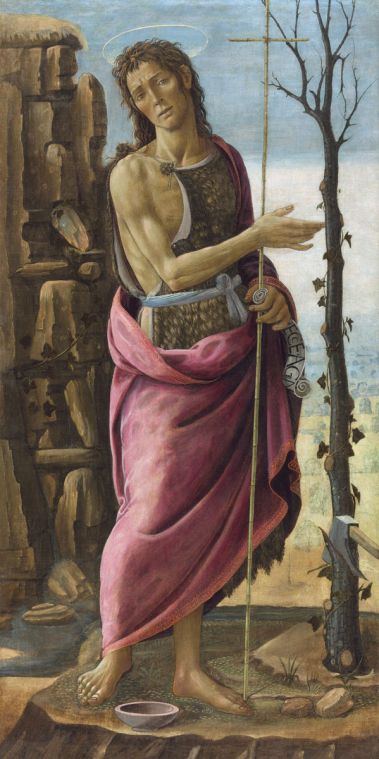
Two images. Same subject (John the Baptist). Same setting (as we see him in the gospel lesson for Advent 3C...Luke 3:7-18). Same artist (Jacopo del Sallaio of Florence, Italy). Same pose. Same setting (a landscape). Same colors of garments. But what a difference five years makes. The image on the left was painted about 1480. The image on the right was painted about 1485. How would you characterize the changes?
 (left) Jacopo del Sellaio. St. John the Baptist. c. 1480. National Gallery of Art, Washington, DC. See: https://www.nga.gov/collection/gallery/gg7/gg7-426.html
(right) Jacopo del Sellaio. St. John the Baptist. c. 1485. Szepmuveszeti Muzeum, Budapest, Hungary. See: http://www.szepmuveszeti.hu/adatlap_eng/saint_john_the_baptist_q_9621

What a difference five years makes in how the artist saw the text. John has aged, and his hair has darkened. The landscape that had full green trees is now mostly barren. The goldfinches of the earlier picture have disappeared from the latter. But the ax embedded at the base of the unproductive tree is much more visible. What had been a detail in the first picture has become the main point in the later version.

The reason for the prominence of the ax in 1485 is probably tied up in the life and hometown of the painter. In the earlier picture the city in the background is Florence, Italy. The presence of Florence is not surprising because John the Baptist is the patron saint of the city. Brunelleschi's cathedral dome is identifiable, along with the tower of the Palazzo Vecchio and Giotto's bell tower. The glory of Florence is spread across the painting.

By 1485, though, there was a new resident in Florence, and the city was no longer imagined as a glorious panorama. The new resident was Girolamo Savonarola, a Dominican friar appointed to teach at the San Marco Convent in Florence c. 1482. It was in Florence that Savonarola began preaching about the moral laxness and pagan tendencies of Florence's ruling classes, including the Medici family. His preaching made no real impression on Florence at the time - his delivery and accent were stumbling blocks - but it was the beginning of a decade of preaching that called for reform (in church and at court) and, increasingly, warned of the nearness of the apocalypse.

In other words, Florence should repent, and repent now, because God's judgment was coming. Soon. Or, to quote John, the city of Florence needed to repent, because the ax was already lying at the root of the tree.

Delivering this message didn't provide a better end for Savonarola than it did for John the Baptist. One was beheaded; one was burned at the stake. It might make a preacher a little hesitant to bring up the whole subject.

For thoughts on Zephaniah 3:14-20, click here.