This week...take a look at two past essays about the texts for this week. Reconsider what they have to say about these texts.
For thoughts on the language of John 17:6-9, strongly related to John 15:20-26, click here:
For thoughts on chains (Acts 16:16-34) click here.

Celebrating our creative and living God by generating art and architecture resources for congregations and individuals.
Showing posts with label John. Show all posts
Showing posts with label John. Show all posts
Sunday, May 26, 2019

Sunday, October 14, 2018
Mark 10.35-45: Prepared for Whom?
It is for those for whom it has been prepared. That's what Jesus tells James and John when they ask to sit beside him in glory. To sit at my right hand or at my left is not mine to grant, but it is for those for whom it has been prepared. But it begs the question: For whom has it been prepared?
In art, Jesus in glory seems to be most-often surrounded by a host of angels or by symbols of the four gospels (and remember their relationship to Ezekiel's creatures and the creatures in Revelation). Annibale Caracci's "Christ in Glory" (below left) has Peter on Jesus' right and John on Jesus' left. At least one of the brothers made it in that version. A search for "Jesus in Glory" or "Christ in Glory" often shows the Transfiguration - where Elijah and Moses flank Jesus. No disciple emerges as a favorite in those depictions.
In art, Jesus in glory seems to be most-often surrounded by a host of angels or by symbols of the four gospels (and remember their relationship to Ezekiel's creatures and the creatures in Revelation). Annibale Caracci's "Christ in Glory" (below left) has Peter on Jesus' right and John on Jesus' left. At least one of the brothers made it in that version. A search for "Jesus in Glory" or "Christ in Glory" often shows the Transfiguration - where Elijah and Moses flank Jesus. No disciple emerges as a favorite in those depictions.
Another thought process says that if Jesus is seated at the right hand of God, then God would be sitting on Jesus' left. The best candidate for whom would be on Jesus' right is his mother Mary, often depicted as the queen of Heaven. The rightful place for a queen is at the king's right hand. In the thirteenth-century mosaic shown here, Jesus is enthroned, with Mary standing at Jesus' right hand and St. Mark is at his left hand. The mosaic is located on the main portal of St. Mark's Basilica in Venice. Again, James and John miss out.


For thoughts on Job 38, click here.
For additional thoughts on the disciples' request for greatness, see this week's Facebook post.


(Left) Annibale Carracci. Christ in Glory. 1597-1598. Florence, Italy: Palazzo Pitti. (Right) Main portal mosaic. c. 1250. Basilica di San Marco, Venice, Italy.
There is, of course, a time in scripture where two people are given places on either side of Jesus. And though James and John promised that they could drink the cup and be baptized with the baptism, they probably didn't have this in mind. Jesus is crucified between two thieves. At least on the day of crucifixion they were the ones on Jesus' left and right. Is that something like the last being first?For thoughts on Job 38, click here.
For additional thoughts on the disciples' request for greatness, see this week's Facebook post.
Sunday, August 12, 2018
John 6.51-58: Bread...Again
Have you ever noticed how many times scripture talks about bread? Art&Faith Matters has talked about it here and here and here and here. And just for good measure, there is manna here. There is lots of bread in scripture, and in John 6:51-58 a connecting line is drawn between bread and manna: This is the bread that came down from heaven, not like that which your ancestors ate...

But there are others who are not waiting for the manna to fall. They have baskets raised in order to collect the manna as soon as possible. Compositionally, it works. The figure at the top center is positioned directly beneath the hole in the sky from which the manna falls. A dark funnel-shaped shadow leads directly to the opening of the vessel being held aloft. The dark shadow also highlights the light-colored manna as it falls. Others in the crowd echo his practice and position.
Jesus identified himself as the living bread that came down from heaven. How do we receive that bread? Do we wait for the bread to fall to the ground before we pick it up? Do we think, "Bread (or manna)...again"? Or do we reach above our heads in order to snag that bread out of mid-air so that we can have it at the earliest possible moment? There's a difference.
For thoughts on Solomon's request for wisdom, click here.
For one tradition's use of bread, see Food&Faith Matters here.

Master of the Gathering of the Manna. Gathering of the Manna from the Ashburnam Pentateuch.
1470-1490. Musee de la Chartreuse de Douai.
The picture above is exactly what it describes (and the designation/naming of the artist is drawn from this work). What is interesting, I think, is the manner in which people are gathering the manna. Some are picking up the wafer-shaped manna from the ground. Men, women, and children are all engaged in the task. Babies are held in their mother's arms, and people embrace as the miracle occurs. This is clearly a celebration. As it should be. For the coming decades the people will be fed daily with manna and quail.But there are others who are not waiting for the manna to fall. They have baskets raised in order to collect the manna as soon as possible. Compositionally, it works. The figure at the top center is positioned directly beneath the hole in the sky from which the manna falls. A dark funnel-shaped shadow leads directly to the opening of the vessel being held aloft. The dark shadow also highlights the light-colored manna as it falls. Others in the crowd echo his practice and position.
Jesus identified himself as the living bread that came down from heaven. How do we receive that bread? Do we wait for the bread to fall to the ground before we pick it up? Do we think, "Bread (or manna)...again"? Or do we reach above our heads in order to snag that bread out of mid-air so that we can have it at the earliest possible moment? There's a difference.
For thoughts on Solomon's request for wisdom, click here.
For one tradition's use of bread, see Food&Faith Matters here.
Monday, May 7, 2018
John 17.6-19: Language and Rhythm
Jesus is praying for the disciples in John 17:6-19 (Easter 7B). In this passage, yours and mine and I and you and they weave together, each one occasionally popping up like dolphins in an ocean pod surface in turn as they move through the water.
Or like the over-and-under of a Celtic knot. Now mine. Now yours. Now them. Now me. Now I. Now you. Now they. Jesus' words flow in sentences that move over and under and back around again as he prays for the disciples and to God.
 Be sure to read the text out loud and hear the rhythm of it.
John 17:6-19
I have made your name known to those whom you gave me from the world. They were yours, and you gave them to me, and they have kept your word.
Now they know that everything you have given me is from you; for the words that you gave to me I have given to them, and they have received them and know in truth that I came from you; and they have believed that you sent me.
I am asking on their behalf; I am not asking on behalf of the world, but on behalf of those whom you gave me, because they are yours.
All mine are yours, and yours are mine; and I have been glorified in them.
And now I am no longer in the world, but they are in the world, and I am coming to you. Holy Father, protect them in your name that you have given me, so that they may be one, as we are one.
While I was with them, I protected them in your name that you have given me. I guarded them, and not one of them was lost except the one destined to be lost, so that the scripture might be fulfilled.
But now I am coming to you, and I speak these things in the world so that they may have my joy made complete in themselves.
I have given them your word, and the world has hated them because they do not belong to the world, just as I do not belong to the world.
I am not asking you to take them out of the world, but I ask you to protect them from the evil one.
They do not belong to the world, just as I do not belong to the world.
Sanctify them in the truth; your word is truth.
As you have sent me into the world, so I have sent them into the world.
And for their sakes I sanctify myself, so that they also may be sanctified in truth.
Or like the over-and-under of a Celtic knot. Now mine. Now yours. Now them. Now me. Now I. Now you. Now they. Jesus' words flow in sentences that move over and under and back around again as he prays for the disciples and to God.

John 17:6-19
I have made your name known to those whom you gave me from the world. They were yours, and you gave them to me, and they have kept your word.
Now they know that everything you have given me is from you; for the words that you gave to me I have given to them, and they have received them and know in truth that I came from you; and they have believed that you sent me.
I am asking on their behalf; I am not asking on behalf of the world, but on behalf of those whom you gave me, because they are yours.
All mine are yours, and yours are mine; and I have been glorified in them.
And now I am no longer in the world, but they are in the world, and I am coming to you. Holy Father, protect them in your name that you have given me, so that they may be one, as we are one.
While I was with them, I protected them in your name that you have given me. I guarded them, and not one of them was lost except the one destined to be lost, so that the scripture might be fulfilled.
But now I am coming to you, and I speak these things in the world so that they may have my joy made complete in themselves.
I have given them your word, and the world has hated them because they do not belong to the world, just as I do not belong to the world.
I am not asking you to take them out of the world, but I ask you to protect them from the evil one.
They do not belong to the world, just as I do not belong to the world.
Sanctify them in the truth; your word is truth.
As you have sent me into the world, so I have sent them into the world.
And for their sakes I sanctify myself, so that they also may be sanctified in truth.
For thoughts on the call of Matthias, click here.
Sunday, December 27, 2015
In the Beginning
It's an old art history trivia question that speaks to the gospel reading for Christmas 2C (John 1:1-18). Here's the set up: in Michelangelo's Creation of Adam, we know that God's right hand reaches out to the newly created Adam. (Detail below.) Here's the question: where is God's left hand and arm? Don't look at the full view until you've made a guess.

There is no definitive answer, but there are theories. All the theories wind up with the infant as the Christ Child, so it is the identity of the woman that shapes the meaning of the composition. One theory identifies the female figure as Eve, waiting her turn to be created. Eve, whose name means life, will be the mother of all humanity. A second casting of the figures calls the female figure Mary, who will be the literal mother of Jesus. A third option is that the female figure is Wisdom (see Proverbs 8:22ff.). Yet another proposal is that the female figure is the Holy Spirit (ruach, a feminine noun, in the Hebrew). With this interpretation, the figures become the Trinity, all three persons present in the beginning.

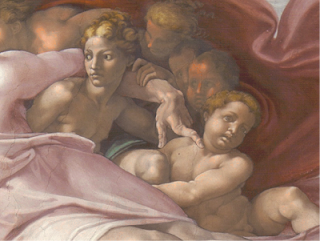 Each of the above propositions concludes with the identification of the infant as the Christ Child. The interpretations by turn feature the Christ as the second Adam, the son of God and one person of the Trinity. However it is interpreted, Michelangelo has caused the hand of God to rest eternally on the child. The artist has placed the Word in the beginning, exactly where John's gospel said he was.

On Art&Faith Matters' Facebook page this week...Epiphany! Travel with the magi by clicking here.

Michelangelo. Creation of Adam (detail). Sistine Chapel, 1508-1512. Vatican City, Italy. http://mv.vatican.va/3_EN/pages/CSN/CSN_Volta_StCentr.html
OK, now look at the bottom of the page for the full view. Was it what you thought? And, actually what is it? Obviously it's God and a number of other figures floating in space on a cloak-like background. God's left arm is around a female figure, and God's left hand is touching an infant. Who are they?There is no definitive answer, but there are theories. All the theories wind up with the infant as the Christ Child, so it is the identity of the woman that shapes the meaning of the composition. One theory identifies the female figure as Eve, waiting her turn to be created. Eve, whose name means life, will be the mother of all humanity. A second casting of the figures calls the female figure Mary, who will be the literal mother of Jesus. A third option is that the female figure is Wisdom (see Proverbs 8:22ff.). Yet another proposal is that the female figure is the Holy Spirit (ruach, a feminine noun, in the Hebrew). With this interpretation, the figures become the Trinity, all three persons present in the beginning.


On Art&Faith Matters' Facebook page this week...Epiphany! Travel with the magi by clicking here.
Sunday, December 6, 2015
Luke 3.7-18: Chop Down a Tree
Two images. Same subject (John the Baptist). Same setting (as we see him in the gospel lesson for Advent 3C...Luke 3:7-18). Same artist (Jacopo del Sallaio of Florence, Italy). Same pose. Same setting (a landscape). Same colors of garments. But what a difference five years makes. The image on the left was painted about 1480. The image on the right was painted about 1485. How would you characterize the changes?


What a difference five years makes in how the artist saw the text. John has aged, and his hair has darkened. The landscape that had full green trees is now mostly barren. The goldfinches of the earlier picture have disappeared from the latter. But the ax embedded at the base of the unproductive tree is much more visible. What had been a detail in the first picture has become the main point in the later version.
The reason for the prominence of the ax in 1485 is probably tied up in the life and hometown of the painter. In the earlier picture the city in the background is Florence, Italy. The presence of Florence is not surprising because John the Baptist is the patron saint of the city. Brunelleschi's cathedral dome is identifiable, along with the tower of the Palazzo Vecchio and Giotto's bell tower. The glory of Florence is spread across the painting.
By 1485, though, there was a new resident in Florence, and the city was no longer imagined as a glorious panorama. The new resident was Girolamo Savonarola, a Dominican friar appointed to teach at the San Marco Convent in Florence c. 1482. It was in Florence that Savonarola began preaching about the moral laxness and pagan tendencies of Florence's ruling classes, including the Medici family. His preaching made no real impression on Florence at the time - his delivery and accent were stumbling blocks - but it was the beginning of a decade of preaching that called for reform (in church and at court) and, increasingly, warned of the nearness of the apocalypse.
In other words, Florence should repent, and repent now, because God's judgment was coming. Soon. Or, to quote John, the city of Florence needed to repent, because the ax was already lying at the root of the tree.
Delivering this message didn't provide a better end for Savonarola than it did for John the Baptist. One was beheaded; one was burned at the stake. It might make a preacher a little hesitant to bring up the whole subject.
For thoughts on Zephaniah 3:14-20, click here.

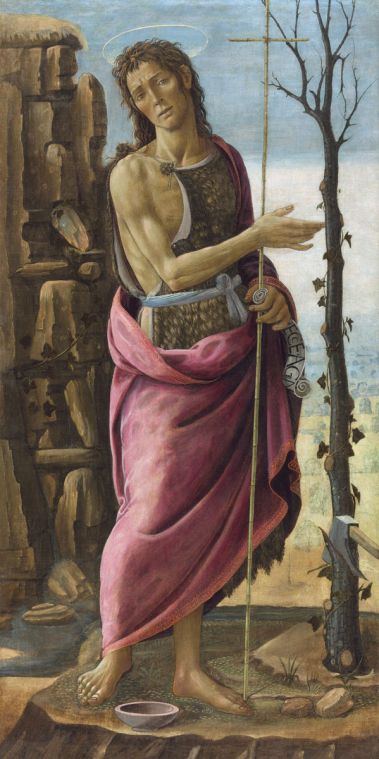
(left) Jacopo del Sellaio. St. John the Baptist. c. 1480. National Gallery of Art, Washington, DC. See: https://www.nga.gov/collection/gallery/gg7/gg7-426.html
(right) Jacopo del Sellaio. St. John the Baptist. c. 1485. Szepmuveszeti Muzeum, Budapest, Hungary. See: http://www.szepmuveszeti.hu/adatlap_eng/saint_john_the_baptist_q_9621
What a difference five years makes in how the artist saw the text. John has aged, and his hair has darkened. The landscape that had full green trees is now mostly barren. The goldfinches of the earlier picture have disappeared from the latter. But the ax embedded at the base of the unproductive tree is much more visible. What had been a detail in the first picture has become the main point in the later version.
The reason for the prominence of the ax in 1485 is probably tied up in the life and hometown of the painter. In the earlier picture the city in the background is Florence, Italy. The presence of Florence is not surprising because John the Baptist is the patron saint of the city. Brunelleschi's cathedral dome is identifiable, along with the tower of the Palazzo Vecchio and Giotto's bell tower. The glory of Florence is spread across the painting.
By 1485, though, there was a new resident in Florence, and the city was no longer imagined as a glorious panorama. The new resident was Girolamo Savonarola, a Dominican friar appointed to teach at the San Marco Convent in Florence c. 1482. It was in Florence that Savonarola began preaching about the moral laxness and pagan tendencies of Florence's ruling classes, including the Medici family. His preaching made no real impression on Florence at the time - his delivery and accent were stumbling blocks - but it was the beginning of a decade of preaching that called for reform (in church and at court) and, increasingly, warned of the nearness of the apocalypse.
In other words, Florence should repent, and repent now, because God's judgment was coming. Soon. Or, to quote John, the city of Florence needed to repent, because the ax was already lying at the root of the tree.
Delivering this message didn't provide a better end for Savonarola than it did for John the Baptist. One was beheaded; one was burned at the stake. It might make a preacher a little hesitant to bring up the whole subject.
For thoughts on Zephaniah 3:14-20, click here.
Sunday, December 7, 2014
John 1: John...An Angel?
The Orthodox tradition refers to Jesus' cousin (and baptizer) John as the Forerunner. In some icons he is written as the Angel of the Desert. The oversize wings are probably the most obvious reason for John's identification as an angel. We should remember that the word angelos can mean angel but also messenger, and certainly John was a messenger, as described in John 1 (the gospel reading for Advent 3B).

In his hand John holds a scroll, generally a symbol of a prophet. In Christian tradition, John is the final prophet in the line of prophets in Hebrew scripture who foretold the Messiah.
Surrounding the figure are episodes from the life of John the Forerunner. Some are familiar - his birth, the dance of Salome, his beheading. Other episodes are from legend. At the left of the composition, an angel leads the infant John into the wilderness. As told in the Prologue of Ohrid (1928), to escape Herod's order to murder the children, Elizabeth took John to the wilderness. They were pursued by soldiers but hid in a miraculous opening in the rock. Zechariah was slain at the altar on Herod's order - Herod being furious that John had not been killed. Forty days after Zechariah's death Elizabeth also died. John stayed in the wilderness being fed and cared for by an angel of God.
Often John is perceived as the slightly quirky (locusts, honey, animal fur) member of Jesus' family. Does your perception of him change if he is known as the Angel of the Desert?
 Take a closer look at the audience drawn to the river by John's preaching on the Art&Faith Matters Facebook page.
This week's Food&Faith Matters page considers gardens, seeds and sheaves from Lent 3B's readings in Isaiah 61 and Psalm 126. The link is at the bottom of the page.
For thoughts on the reading from Hebrew scripture (Isaiah 61), click here.
John the Forerunner. 17th century. Moscow School. Trevetyakov Gallery.
In icons of John the Forerunner, the central figure is shown large, with body-length wings, usually holding a scroll and a chalice (or salver or footed paten called a diskos, the dish that holds the bread) and a scroll. Sometimes the chalice contains John's own head, a prefiguring of his beheading. In the icon shown, the chalice contains the figure of Christ, naked and lying down. John points to the Christ, in the icon as he will in life.In his hand John holds a scroll, generally a symbol of a prophet. In Christian tradition, John is the final prophet in the line of prophets in Hebrew scripture who foretold the Messiah.
Surrounding the figure are episodes from the life of John the Forerunner. Some are familiar - his birth, the dance of Salome, his beheading. Other episodes are from legend. At the left of the composition, an angel leads the infant John into the wilderness. As told in the Prologue of Ohrid (1928), to escape Herod's order to murder the children, Elizabeth took John to the wilderness. They were pursued by soldiers but hid in a miraculous opening in the rock. Zechariah was slain at the altar on Herod's order - Herod being furious that John had not been killed. Forty days after Zechariah's death Elizabeth also died. John stayed in the wilderness being fed and cared for by an angel of God.
Often John is perceived as the slightly quirky (locusts, honey, animal fur) member of Jesus' family. Does your perception of him change if he is known as the Angel of the Desert?
This week's Food&Faith Matters page considers gardens, seeds and sheaves from Lent 3B's readings in Isaiah 61 and Psalm 126. The link is at the bottom of the page.
For thoughts on the reading from Hebrew scripture (Isaiah 61), click here.