Showing posts with label Job. Show all posts

Monday, October 22, 2018

Job 42.1-6, 10-17: Daughters

It is a truth universally acknowledged that throughout history, it was often better to be a son than a daughter. And better to be a first-born son than a second (or third!) son. The eldest son sometimes got everything, but more often than not, he received at least more than any other son. Daughters may have inherited their mother's jewelry and perhaps the family china or silver (unless the silver was monogrammed, which meant the oldest son's family would probably get it). It's interesting, then, that the writer of Job is careful to record that when his fortunes were restored, Job gave his three daughters an inheritance along with their brothers (Job 42:15).
William Blake. Job and His Daughters. 1799/1800. Pen and tempera on canvas. Washington, DC: National Gallery of Art.
This is not the first time that daughters have inherited. Just before the Israelites cross into the Promised Land, Zelophehad's offspring bring a case before Moses who takes it to God. These offspring, five daughters, are protesting the practice of only letting sons inherit. Their request is that they be allowed to inherit portions of their father's estate along with their uncles. They argue that their father's name should not be lost to his tribe just because there are no male heirs.

God agreed. 7The daughters of Zelophehad are right in what they are saying; you shall indeed let them possess an inheritance among their father’s brothers and pass the inheritance of their father on to them. 8You shall also say to the Israelites, ‘If a man dies, and has no son, then you shall pass his inheritance on to his daughter. 9If he has no daughter, then you shall give his inheritance to his brothers. 10If he has no brothers, then you shall give his inheritance to his father’s brothers. 11And if his father has no brothers, then you shall give his inheritance to the nearest kinsman of his clan, and he shall possess it. It shall be for the Israelites a statute and ordinance, as the Lord commanded Moses.’ (Numbers 27:7-11)

Zelophehad's daughters - Mahlah, Noah, Hoglah, Milcah, and Tirzah - are allowed to inherit in the absence of male heirs. But notice that Job's three daughters - Jemimah, Keziah, and Keren-happuch - inherit alongside their brothers. Job's restored fortunes also mean a restored "flock of children." Job has seven sons to go along with his three daughters. In a reversal of usual practice, here the daughters are named while the sons remain just "seven sons." For these daughters the end of Job's story wasn't  restoration but a whole new array of possibilities for life.

For thoughts on the healing of Bartimaeus, click here.

Sunday, September 30, 2018

Job 1.1, 2.1-10: Meanwhile, Back at the Ranch

It's interesting to think about what is going on the world right now that will come to pass in the future. Seeds are being planted that will become next spring's flowers. People I don't yet know are moving through their lives on a path that will cross with mine next year...or five years from now. My next job is being readied for me...or maybe things are being orchestrated so that I will stay in my current position for the rest of my work life. You just never know what things are happening out of sight. Job will find that out (Job 1:1, 2:1-10).

Bartolo di Fredi was, in the second half of the fourteenth century, the most important painter in Siena, Italy. He had a large working studio and was a registered member of his town's Guild. He assisted with the commission to paint the Council Hall in Siena in 1361. Earlier, beginning in 1356, he had been commissioned to decorate the Collegiata (principal church) of San Gimignano - about 20 miles from Siena. The frescoes along the entire left aisle are his work. Given the descriptive title Scenes from the Old Testament, the work was signed and finished in 1367.

Two of those scenes illustrate episodes from the story of Job. This is one of them.
Bartolo di Fredi. God Gives Satan Permission to Tempt Job. 1367. Collegiata Santa Maria Assunta, San Gimignano, Italy. 
In this scene, Job and Mrs. Job (both wearing crowns), along with some of the little Jobs are feasting and making merry. They sit at a table with gold cups and linen tablecloths. Musicians blast herald trumpets, play the bongos (or something like them), and touch the keys of a portative organ. Dogs look for the crumbs that fall from the master's table. Bread is distributed from the door of Job's house at the left of the composition. Three figures (servants? children? townspeople?) gaze down from the top of the composition at the wondrous feast and celebration happening in Job's house. Life is good for Job. He is living like a king and helping others, too.

In silent movies, when the action cuts from one scene or location to another, an intertitle would appear on-screen, giving the audience the information they needed. In westerns, one of the intertitles that often appeared was, "Meanwhile, back at the ranch..." While one character was living life, having adventures away from the ranch, things were still happening back on the ranch. Those things would often influence the main character's life and destiny. He or she would have to come back home to save the ranch from the swindlers or find the rustlers or rescue the one true love from a dastardly interloper.

Job is feasting and listening to music and enjoying family time. But meanwhile, up in heaven (or the upper left corner of Bartolo's fresco), God and the satan are having a conversation that will greatly impact Job's future.

People often say, "If I had known this was coming..." Imagine the traveler heading out of town, boarding the plane, settling in at the hotel. All the while not know that the next day would bring a broken ankle and a hospital stay in that far-away city. If I had known...

Do you wish you knew what was going on "back at the ranch" that would impact your future? Or is it ok if you don't know?

For thoughts on Mark 10.2-16, click here.
Psalm 8 and Hebrews 3:7 are the subject of this week's Art&Faith Matters Facebook page. Click here.

Monday, October 19, 2015

Mark 10.46-52: Bartimaeus...the Entertainer?

Jesus heals blind men in more than one gospel and more than one story in Christian scripture. For Proper 25B/Ordinary 30B/Pentecost 22 the story is that of Bartimaeus, a blind beggar outside Jericho who gains Jesus' attention in order to be healed and then follows Jesus on the way (Mark 10:46-52).

The author of the text tells us that Bartimaeus sits by the roadside, but that is as far as the details go. Italian artist Domenico Fiasella (called Il Sarzano) has given Bartimaeus a sort of occupation that would have been familiar in his own time. Now in the collection of the John and Mable Ringling Museum of Art, the painting called "Christ Healing the Blind" shows Jesus in the familiar red and blue tunic and cloak, laying his hand over the eyes of the blind man. From his fingertips comes...nothing. But we have faith that the man's sight will be restored.
Domenico Fiasella. Christ Healing the Blind. Oil on canvas. 1615. Sarasota, FL: John and Mable
 Ringling Museum of Art. http://ringlingdocents.org/fiasella1.htm
What is especially interesting is that Fiasella has made Bartimaeus a violinist, hanging the fiddle from the belt of his tunic. In Fiasella's day many blind persons had to beg for a living and having the ability to play a musical instrument like a violin or guitar might have made a significant difference in their ability to sustain life.

The theme of the blind musician is a reasonably common theme in art. John Singer Sargent, Georges de la Tour and Ben Shahn among other artists, have explored this theme in their paintings. The theme may have some root in the legend of St. Cecelia, patron saint of musicians. The name Cecilia may come from the Latin caecus (meaning blind), so Cecilia is also patron saint of the blind. There is no evidence that she herself was blind, but the confluence of words and names and meanings has sorted itself out along these lines.

Blindness has traditionally been the occasion to talk about spiritual insight (or its lack), heavenly reward/earthly punishment, the ability of divine healing to override the things of earth and the salvation of humans and humanity. Sight, light and salvation are often associated with these stories. The addition of music to the composition is an interesting one. Oftentimes we think of musicians being "lost in their music" - so caught up in the moment that they lose awareness of the world around them. This might be doubly true of blind musicians. But here the blind man is not so caught up in his music that he has missed Christ walking by. The violin that surely has made music in the past may make music in the future, but in this moment it hangs otherwise unattended at the man's waist. This blind man, whether he is Bartimaeus or another, is not distracted by his own activity or any other need. He is rather intently focused on Christ who can and will change his world.

For thoughts on Job 42.1-6, 10-17, click here.

Sunday, October 11, 2015

Job 38: From the Whirlwind

God shows up. And God has an answer for Job in the reading for Proper 23/Ordinary 28/Pentecost +20 (selected verses from Job 38). God speaks out of a whirlwind, so not only does Job get God, Job gets drama. Big drama. Big weather. And out of the whirlwind God reminds Job that it was God who laid the foundation of the created world. It was God who flung the lights into space and started the planets whirling. It was God who formed the hippo and the alligator. It was God who spat out the oceans. God whose hands clapped and thunder rolled. God who orchestrated the rising of trees and the greening of leaves. God. All God.

Other voices have spoken out of other storms, other whirlwinds. Mississippi artist H.C. Porter helped people find their voices after Hurricane Katrina decimated the coast of her native state in 2005. She spent a year traveling the Mississippi Gulf Coast. She listened to sufferers, and she told their stories through her work as a mixed media artist. Many of those stories were stories of resilience and faith overcoming the loss of everything that the world would consider important. Others told other stories. While Porter told their stories visually, her subjects also told their stories orally, and those voice recordings accompany the paintings in the exhibition. They are speaking out of a whirlwind.

It's difficult to name a person whose life has not been touched in some way by loss, sorrow and the question of why God seems absent. Certainly Job's life was touched by loss, and he felt that God was nowhere near to him. But God's answer to Job reminds us of the psalmist's assurance that God is present and we need not fear, even if the mountains shake in the heart of the sea. Ralph Waldo Emerson wrote, "All I have seen teaches me to trust the Creator for all I have not seen." We, too, can trust the God who made all that is.

For H.C. Porter's exhibition "Backyards and Beyond: Mississippians Tell Their Stories", see: http://www.hcporter.com/katrina/index.asp. For the published catalog that accompanied the exhibition, see: http://www.amazon.com/Backyards-Beyond-Mississippians-Their-Stories/dp/0981849903 Original work is available on the artist's website.

For thoughts on Mark 10:35-45, click here.

Sunday, October 4, 2015

Without God or Jesus, A Single Figure

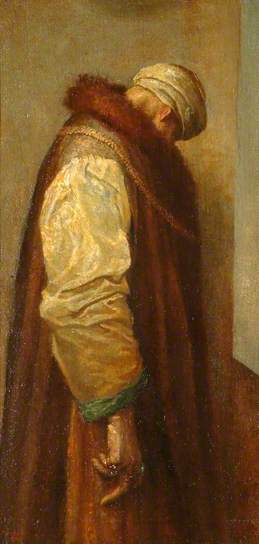
The gospel reading and the reading from Hebrew scripture for Proper 23B/Ordinary 28B/Pentecost 20 leave us with a single figure. One because he is unable to follow. One who cannot seem to find. The two readings (Mark 10:17-31 and Job 23:1-17 respectively) detail encounters between a human and the divine. In one passage the human is young; in the other he is old (or at least middle age!). In one passage the human has great material possessions; in the other he once had such possessions, but they have been taken away from him.
(Both) George Frederic Watts. For He Had Great Possessions. 1894.
 (Left) Guildford, Surrey: Watts Gallery. http://wattsgallery.adlibsoft.com/detail.aspx?parentpriref=
(Right) London: Tate Gallery. http://www.tate.org.uk/art/artworks/watts-for-he-had-great-possessions-n01632
Above are two versions of the same composition titled "For He Had Great Possessions" by George Frederic Watts. Watts was a 19th-century Symbolist painter. He is credited with saying, "I paint ideas, not things. My intention is less to paint works that are pleasing to the eye than to suggest great thoughts which will speak to the imagination and the heart and will arouse all that is noblest and best in man." Watts' intention to paint ideas shows clearly in the paintings. Where other artists show Jesus and a group of people, here the focus is entirely on the young man and his state of mind.

The two versions vary slightly. The shallow picture space emphasizes the limited future of the man, even as his rich clothes remind us of all the material possessions he has. The placement of a vertical line and the fullness of his fur collar are among the variations between the two pictures.
Leon Bonnat. Job. 1880. Musee Bonnat Helleu. 
For Musee Bonnat Helleu, see: http://webmuseo.com/ws/musee-bonnat-helleu/app/report/index.html
Bonnat's painting of Job also shows a figure alone (though Job might not be entirely sad about being alone, given the company he usually keeps - his friends, his wife. Job faces us, where Watts' young man had turned away. The background here is also shallow, though the darkness leaves some room for mystery. Job is dramatically lighted as he sits alone on the dungheap looking up blindly to a God he cannot seem to find. 

You might think that having a single figure as the focus of a composition would give the figure a monumental strength. In these examples, however, the compositions seem to emphasize their barrenness and isolation. How different Job's life will be when God finally shows up. How different the young man's life would have been if he had made a different choice.